Laura Schmid lives and works in Seoul, South Korea, and is the Launch Chief Editor of the upcoming journal Nature Reviews Computing. She will receive the award in recognition of her impressive career path after earning her PhD at ISTA and in honor of her ongoing commitment to interdisciplinary science. She is the fifth recipient of the award, which will be presented as part of the ISTA Alumni Reunion in October.
For Catherine McKenzie, the journey to the Institute of Science and Technology Austria (ISTA) in 2013 was a collision of personal and professional magnetism. While her relocation was prompted by a personal connection to the region, the primary catalyst for her commitment was the “dynamic and creative scientific environment” offered at ISTA. Catherine took a leap of faith backed by the endorsement of trusted mentors and the new arrival of well-respected neuroscientists, Jozsef Csicsvari and Peter Jonas.
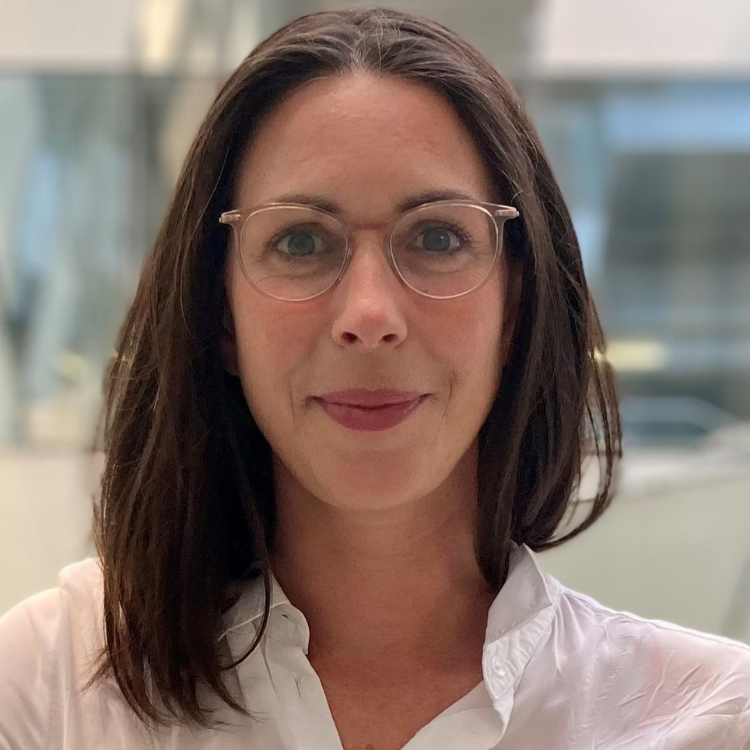
“I have no regrets,” she recalls about completing her PhD at ISTA in 2018.
Though she ultimately joined the Janovjak group, she never felt limited by the rigid departmental structures prevalent in other institutions and engaged frequently with scientists across other fields and disciplines. The coffee area was a regular hotbed for debate and Catherine recalls one such instance with a professor who wanted to model synaptic weights. Catherine contended that the sheer plasticity of a neuron’s fundamental unit made it impossible to account for every necessary variable. Rather than being dismissed, she was met with rigorous engagement. “It was so cool that this professor, who wasn’t even my supervisor, was fully engaging with me,” she reflects.
During her time at ISTA, Catherine mastered the art of manipulating synaptic proteins using chemo- and optogenetics. This expertise propelled her through her time as a postdoc at the Interdisciplinary Institute for Neuroscience in France and eventually into her current role as a Discovery Scientist at Roche in Switzerland. Today, her work is at the cutting edge of precision medicine. Developing treatments for disorders that currently have no medical recourse, she identifies dysfunctional genes and replaces them with healthy counterparts. She is currently applying these methodologies along with others to neuromuscular disorders in order to restore patient health.
Outside of her work and the lab, she typically keeps a puzzle nearby as something that she can pick up, put down, and leisurely do over time without pressure—or so she thought. “I made the gross mistake of getting a New Yorker puzzle because it had dogs on it. It is unreasonable that anybody could find any connecting piece.” As the frustrating puzzle remains out for Catherine to work on, it is fair to guess that she approaches her downtime hobby with the same energy she has approached science through her academic and professional careers. “It was really just about what set my brain on fire, and I chose that over and over and over again. If you follow what makes you feel electric on the inside, you are going to go far.”
—
* The Janovjak group is no longer affiliated with ISTA.
Fendrych, a group leader at the Czech Academy of Sciences in Prague, received the award in honor of his impact on the auxin field at large, including his contributions at the Institute of Science and Technology Austria (ISTA) when he was a postdoc. He is the fourth recipient of the award.
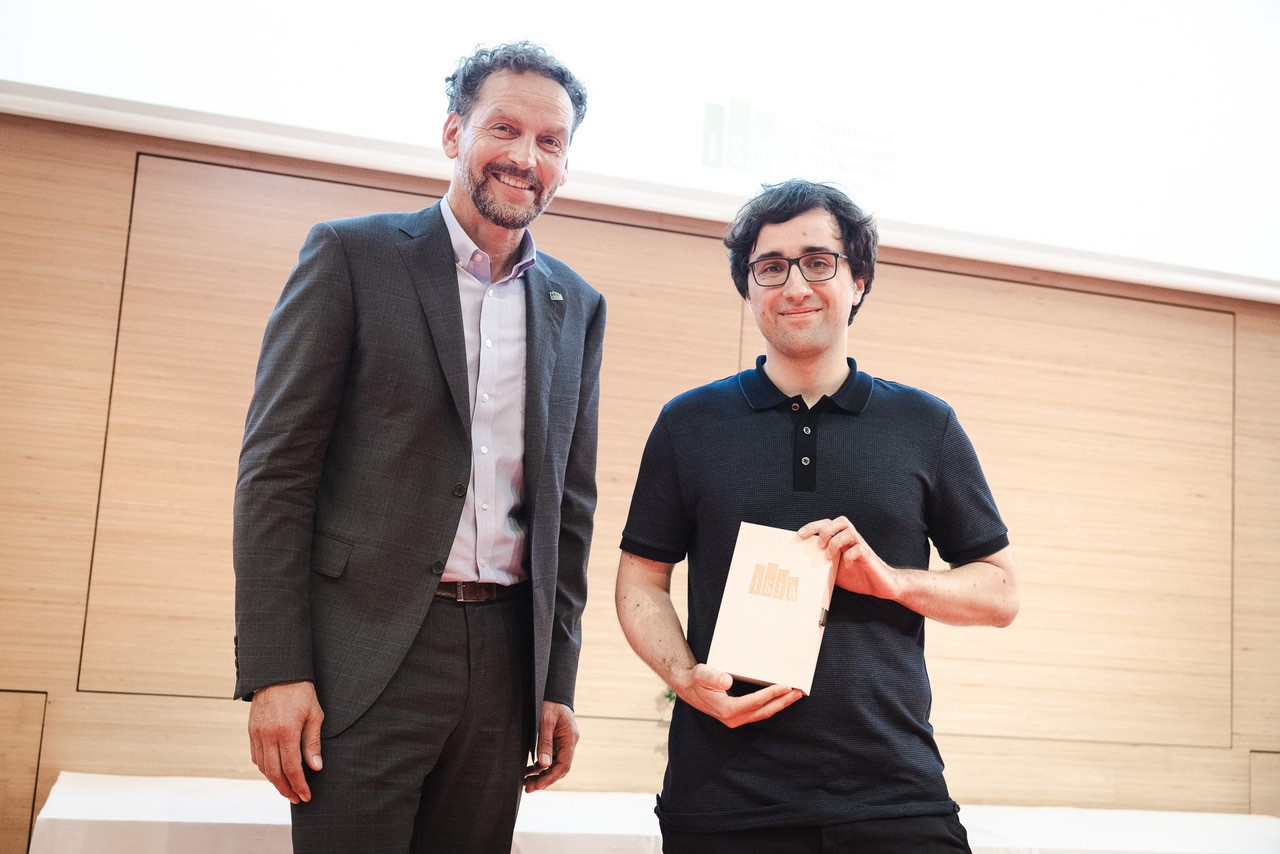
The ISTA Alumni Award 2023, given to excellent former ISTA researchers, was presented during the Graduation Ceremony of the ISTA Graduate School at the end of June. Awardee Alexander Kolesnikov is a great example of what the future can hold for excellent PhD students after graduating from ISTA: he received his doctorate in 2018, is currently working at Google Research in Zurich.
Already during his PhD, Kolesnikov focused on the design of computer systems that can automatically learn to parse and understand visual information, like images or videos. “The crux of my research lies in enhancing the efficiency with which computers learn to interpret visual data from examples,” Kolesnikov explains. What he has begun at ISTA’s Lampert group focusing on machine learning and computer vision, he is still pursuing at Google now—and that very successfully, as his former supervisor Christoph Lampert points out: “Not even five years after his PhD, Alexander has become a highly cited scholar in his field. He has made an astonishing number of influential contributions to computer vision, most notably the creation of machine learning algorithms, so called Vision Transformers. These have now become the foundation of most state-of-the-art computer vision models, both academic and well as commercial.”
This is one of the many reasons making Kolesnikov a worthy winner of the alumni award, which he received at the ceremony this Thursday. And the appreciation clearly is mutual. “I am deeply honored to receive the ISTA Alumni Award,” Kolesnikov said. “This recognition holds special significance for me, as ISTA has played a pivotal role in shaping me as a scientist.”
UNIVERSITY HOSPITAL BASEL, SWITZERLAND
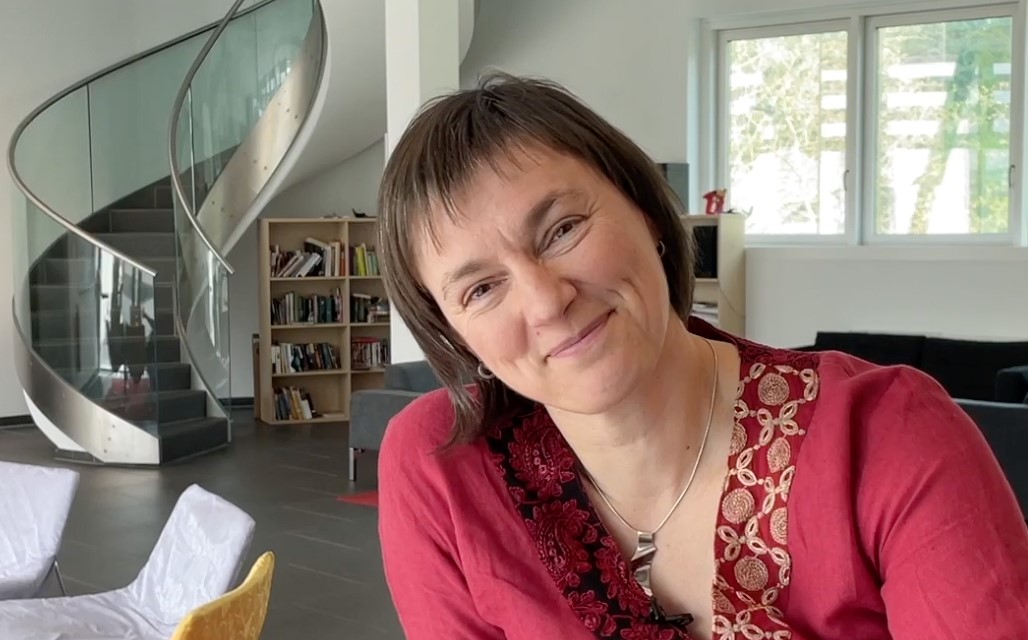
Janina Kowalski was a Postdoc in the Jonas group. She now works as a neuroscientist, psychiatrist, general practitioner, and trauma-therapist in Basel, Switzerland. In April 2022 she visited the ISTA campus to take a walk down memory lane and answer some questions about her work and career.
Watch the corresponding video on YouTube
Well, I’m taking care of people, enabling them, helping them find themselves, to find a better way of living their lives, even if they have had serious troubles in the past.
Well I started off as an MD. Then I did a PhD in neuroscience and I was basically working on patch-clamp recordings in the brain. First, in Freiburg im Breisgau and then I moved with my postdoc lab to the ISTA.
I see myself in the future indeed continuing that work but going even more into experimental approaches and into research mostly focusing on trauma therapy.
Well I could dive deeper into basic science techniques and the thing I cherished the most here was the connection between different groups from different fields. Not only from neuroscience. That was very inspiring for me.
Well, the nights on the bridge during late focused research times. Chatting to other people from other labs. These were quite amazing.
Follow your ideals and your heart and your brain. Don’t pick only one. And talk about yourself, talk about troubles, look for other people, who might want to listen. And: Don’t let yourself get distracted by what the global opinion is. Do your thing. Stay true to yourself.
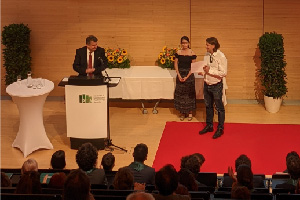
For the first time, ISTA presented an outstanding achievement award to an alumnus. The ISTA Alumni Award went to former ISTA postdoc Anton Mellit, an outstanding mathematician who, according to his former group leader Prof. Tamas Hausel, “works in four to five different areas of mathematics simultaneously and achieves extraordinary success.” The Ukrainian is currently an associate professor at the University of Vienna and has gained international attention for his work on knot theory, algebraic combinatorics, algebraic geometry, and number theory.