
Asterics — Asteroseismology and Stellar Dynamics
Astronomy

1 Career
- Since 2023 Assistant Professor, Institute of Science and Technology Austria (ISTA)
- 2020 – 2022 Flatiron Research Fellow, Center for Computational Astrophysics, Flatiron Institute, NY, USA
- 2017 – 2020 PhD, Astrophysics Department, CEA Saclay & University Paris-Cit´e, Gif-sur-Yvette, France
1.1 Selected Distinctions
- Since 2026 Associate Editor for Stellar physics for the Astronomy and Astrophysics journal (A&A)
- 2025 Organizer of the TASC9/KASC16 Workshop, ISTA, July 2025
- FWO Postdoctoral Fellowship, Belgium (declined due to the Assistant Professor position at ISTA)
- 2021 PhD Prize of the European Astronomical Society — Division G
- 2021 PhD Prize of the French Society of Astronomy and Astrophysics
1.2 Selected Grants
- 2024 – 2029 ERC-2024-STG – HORIZON-ERC HORIZON ERC Grants, Calcifer, Grant number 101165631, PI: L. Bugnet (ISTA). Awarded: € 1,499,309.
- 2025 – 2027 DOC Fellowship of the Austrian Academy of Science, PI: L. Barrault (ISTA). Awarded: € 101,136.
1.3 Tech Transfer (Patents, Spin-Offs)
N/A
1.4 Selected Publications
- L. Einramhof, L. Bugnet, L. M. Calcaferro, L. Barrault, and S. B. Das, “Magneto-archeology of white dwarfs – revisiting the fossil field scenario with observational constraints during the red giant branch,” A&A, vol. 708, p. L14, Apr. 2026. DOI: 10.1051/0004- 6361/202659069. [Online]. Available: https://doi.org/10.1051/0004-6361/202659069.
- B. Liagre, A. Desai, L. Einramhof, and L. Bugnet, “Near-degeneracy effects in quadrupolar mixed modes: From an asymptotic description to data fitting,” A&A, vol. 707, A321, Mar. 2026, Art. no. A321. DOI: 10.1051/0004-6361/202558023. arXiv: 2511.05314 [astro-ph.SR].
- L. Barrault, L. Bugnet, S. Mathis, and J. S. G. Mombarg, “Exploring the probing power of γ Dor’s inertial dip for core magnetism: The case of a toroidal field,” A&A, vol. 701, A253, Sep. 2025, Art. no. A253. DOI: 10.1051/0004-6361/202555213. arXiv: 2507.00308 [astro-ph.SR].
- L. Barrault, S. Mathis, and L. Bugnet, “Constraining differential rotation in γ Doradus stars from the properties of inertial dips,” A&A, vol. 694, A225, Feb. 2025, Art. no. A225. DOI: 10.1051/0004-6361/202451541. arXiv: 2412.02849 [astro-ph.SR].
- S. B. Das, L. Einramhof, and L. Bugnet, “Unveiling complex magnetic field configurations in red giant stars,” A&A, vol. 690, A217, Oct. 2024, Art. no. A217. DOI: 10.1051/0004-6361/202450918. arXiv: 2405.20133 [astro-ph.SR].
2 Group Members
- Lucas Barrault, PhD Student since 2023
- Lukas Einramhof, PhD Student since 2024
- Nicolas Muntean, PhD Student since 2025
- Lynn Buchele, Postdoc since 2025
- Armand Leclerc, Postdoc since 2025
- Georgia Priniotaki, Visiting Student since 2026
- Stanislas Sendera Cartailler, Scientific Intern since 2026
3 Research
Stars are the building blocks of Astrophysics, as age estimates in the Universe and planetary habitability rely on our understanding of stellar evolution. A major shift in our understanding of stellar dynamics is underway: fully characterizing stars requires probing their internal processes across all evolutionary stages. Asteroseismology—the study of stellar oscillations driven by internal waves—has emerged as a powerful tool to reveal the structure and dynamics beneath stellar surfaces. Recent advances in this field are challenging existing models of stellar evolution and, consequently, our interpretation of ages in the Universe.
Magnetic fields and their effects on the dynamics of stellar plasma are largely misunderstood and ignored in stellar evolution models, whereas it has been demonstrated for decades that they must play a crucial role in the transport of angular momentum, chemical gradient, and in interactions with surroundings. To successfully address this largely avoided aspect of stellar evolution requires a truly extensive, in-depth effort. Specialized in Magnetoasteroseismology, the group aims to understand the impact of magnetism on the dynamics and evolution of stars. Research in the group combines theory of wave propagation in plasma, stellar evolution models, and observational analyses of asteroseismic data to better probe and characterize stellar magnetic fields, which shed light on the evolution of stars like the Sun.
3.1 Current Scientific Projects/Directions
- Detection and characterization of magnetic fields inside stars with Asteroseismology
- Signatures of magnetic fields in convective cores
- Magnetic fields in radiative interiors from the red giant branch to the white dwarf stage
- Magnetic field survival and evolution
- Effect of magnetism on angular momentum transport in stellar interiors
3.2 Research in Focus
The detection of strong, large-scale magnetic fields at the surfaces of the oldest white dwarfs might
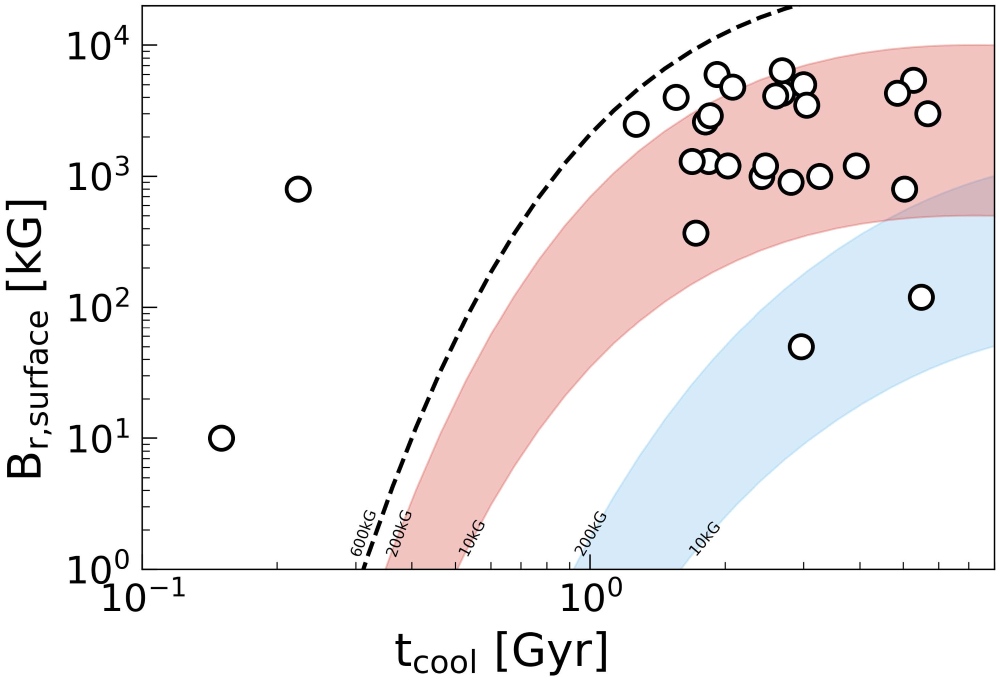
point toward a hidden internal magnetic field slowly rising to the surface. In addition, strong magnetic fields have recently been measured through asteroseismology in the radiative interiors of red giant stars, the progenitors of white dwarfs. To investigate the potential connection between these observations, we revisited the fossil field framework using asteroseismic detections to constrain the strength of such magnetic fields as red giants evolve into the white dwarf stage (see top panel of Figure 1). We find that measured field strengths in red giants attributed to the hydrogen-burning shell are compatible with the field amplitudes and emergence timescales of magnetized white dwarfs (see bottom panel of Figure 1). On the contrary, magnetic fields generated solely from a convectivecore dynamo on the main sequence and detectable on the red giant branch would be buried too deep in the star and would not match the breakout timescales or the field strengths of magnetic white dwarfs. Therefore, connecting magnetic fields observed along the late evolution of stars via a fossil field requires a broadly magnetized internal radiative zone during the red giant branch. This work was published as a Letter to the Editor in the Astronomy and Astrophysics journal: Einramhof et al., 2026 (https://www.aanda.org/articles/aa/full_html/2026/04/aa59069-26/aa59069-26.html).
ISTA press release: https://www.ist.ac.at/en/news/starquakes-and-the-archaeology-of-stellar-magnetism/
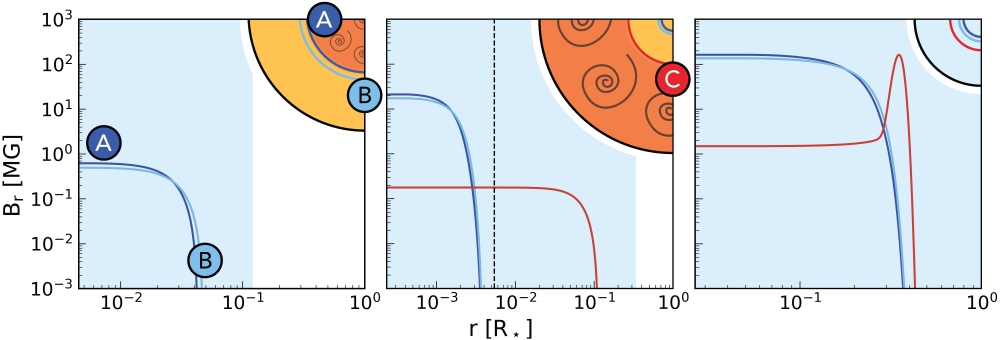
place magnetic fields in the early stellar evolution stages (scenario A and B in the left panel and
scenario C in the middle panel) and co-evolve them with the evolution of the stellar structure
until the white dwarf stage (right panel). The results are represented in the bottom plot, where
the emergence timescales of the corresponding magnetic fields are represented and compared with
observations (white dots). We show that a broadly magnetized red giant branch (scenario C) is
required to explain surface magnetic field observations during the white dwarf stage.

