Systems Neuroscience
Neuroscience

Jozsef Csicsvari
Professor
1 Career
- Since 2011 Professor, Institute of Science and Technology Austria (ISTA)
- 2008 – 2011 MRC Senior Scientist (tenured), MRC ANU University of Oxford, UK
- 2003 – 2008 MRC Senior Scientist (tenure track), MRC ANU, University of Oxford, UK
- 2001 – 2002 Research Associate, Rutgers University, USA
- 1999 – 2001 Postdoctoral Fellow, Rutgers University, USA
- 1999 PhD in Behavioral and Neural Sciences, Rutgers University, USA
- 1993 – 1999 Graduate Assistant, Rutgers University, USA
1.1 Selected Distinctions
- 2026 Plenary Lecture Meeting of the Hungarin Neuroscience Society
- Since 2019 Elected Membership of The Academia Europaea
- 2019 Member of the FENS 2020 European Neuroscience meeting program committee
- Since 2016 Editorial Board, PLOS Biology
- 2010 – 2011 Title of Professor of Neuroscience at the University of Oxford
1.2 Selected Grants
- 2025 – 2029 Austrian Science Fund (FWF) Cluster of Excellence program “Neuronal Circuits in Health and Disease”.
- 2023 – 2026 FWF, Mechanisms underlying hippocampal interneuron plasticity and their role in population activity in vivo € 298,856.
1.3 Tech Transfer (Patents, Spin-Offs)
N/A
1.4 Selected Publications
- C. N. Boccara et al., “The entorhinal cognitive map is attracted to goals,” Science, vol. 363, no. 6425, pp. 443–447, Jan. 2019, http://doi.org/10.1126/science.aav4837.
- K. Kaefer et al., “Replay of behavioral sequences in the medial prefrontal cortex during rule-switching,” Neuron, vol. 106, no. 1, pp. 154–165.e6, Apr. 2020, http://doi.org/10.1016/j.neuron.2020.01.015.
- I. Gridchyn et al., “Assembly-Specific Disruption of Hippocampal Replay Leads to Selective Memory Deficit,” Neuron, vol. 106, no. 2, pp. 291–300.e6, Apr. 2020, http://doi.org/10.1016/j.neuron.2020.01.021.
- D. K. Rangel Guerrero et al., “Hippocampal cholecystokinin-expressing interneurons regulate temporal coding and contextual learning,” Neuron, vol. 112, no. 12, pp. 2045–2061.e10, Jun. 2024, http://doi.org/10.1016/j.neuron.2024.03.019.
- L. Bollmann et al., “Sleep stages antagonistically modulate reactivation drift,” Neuron, vol. 113, no. 9, pp. 1446–1459.e6, May 2025, http://doi.org/10.1016/j.neuron.2025.02.025.
2 Group Members
- Uladzislau Barayeu, PhD Student since 2021
- Sofia Taveira, PhD Student since 2023
- Zsombor Szabo, PhD Student since 2025
- Natalia Babushkina, Postdoc since 2026
- Predrag Zivadinovic, Postdoc since 2026
- Jago Wallenschus, Research Technician since 2015
3 Research
The group investigates the circuit mechanisms underlying spatial learning, specifically examining how memory traces are encoded and refined, and how network events across brain regions contribute to the acquisition, consolidation, and recall of memories. We utilize high-density extracellular recordings in freely moving animals, including 32-tetrode arrays with Neuropixel probes, to monitor large-scale neuronal populations and network oscillations derived from local field potentials. These recordings can be paired with optogenetic stimulation to inhibit or scramble the activity of pyramidal cells or specific interneurons, often triggered by on-the-fly decoding of neuronal activity. Our recent work demonstrated that entorhinal grid cells encode information about recently learned reward locations and showed that selective blockade of memory-specific sleep reactivation patterns disrupted recall of specific spatial memories without interfering with other memories. Current research focuses on a systems-level understanding of meta-learning and strategy development, characterizing the circuit states associated with strategy shifts and execution. Additionally, the lab investigates the temporally changing role of long-duration sleep in the reorganization and stabilization of memory traces, specifically examining “reactivation drift.” Finally, it explores the degree to which optimal dynamical states, such as criticality, facilitate learning and behavioral performance.
3.1 Current Scientific Projects/Directions
- Circuit interactions across brain regions and their potential role in spatial learning and consolidation
- The temporally changing role of sleep in memory representation refinement and drift
- Circuit mechanisms that enable meta-learning involving unfamiliar spatial tasks
- Identification of network dynamical features that facilitate successful learning
3.2 Research in Focus
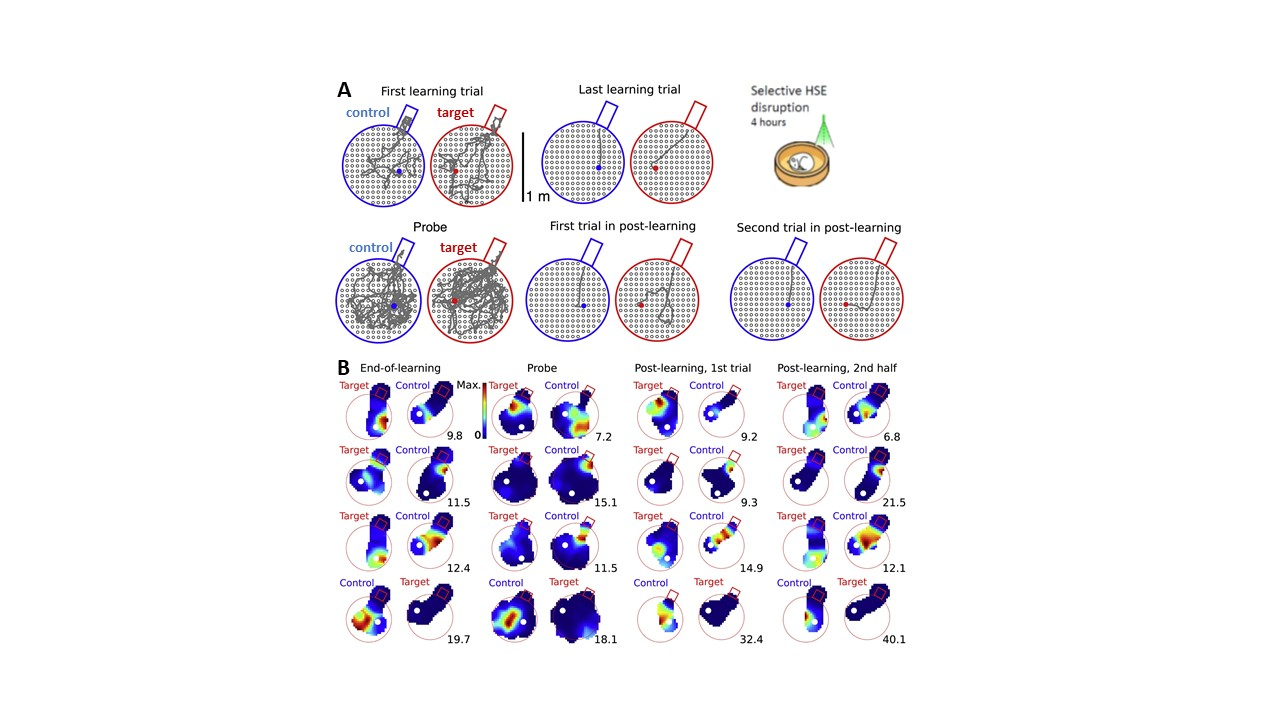
Memory stabilization is essential for recall of recently acquired memories when the interval between learning and retrieval is long enough, a process often involving cellular and systems-level consolidation. In the hippocampus, this stabilization is linked to the reactivation of memory traces during sleep, occurring during sharp-wave ripples (SWRs). While general SWR blockade was known to impair recently learned memories, we aimed to causally demonstrate that reactivation content determines which memories are stabilized for subsequent recall (Gridchyn et al., 2020). To achieve this, we utilized two distinct cheeseboard environments, each with its own reward location. By decoding reactivation content on-the-fly during the intervening sleep period, we selectively disrupted the replay of the target cheeseboard while leaving the control board’s reactivation intact. This approach resulted in a selective recall deficit exclusively on the target cheeseboard, with no impairment observed on the control board. Surprisingly, upon retraining, the animals relearned the blocked location rapidly and the same spatial representation reemerged that was established before the blockade during the first learning. These findings suggested that sleep reactivation was not necessary for the stabilization of the spatial representation itself, but instead was needed for the retrieval of the correct representation for the appropriate context for recall.