
Materials Electrochemistry
Chemistry

1 Career
- Since 2025 Professor, Institute of Science and Technology Austria (ISTA)
- 2020 – 2025 Assistant Professor, Institute of Science and Technology Austria (ISTA)
- 2012 – 2020 Group Leader, Graz University of Technology, Graz, Austria
- 2011 – 2012 EPSRC Early Career Fellow (host: Prof. Sir P.G. Bruce FRS), University of St
Andrews, UK - 2008 – 2011 Postdoc, University of St Andrews, UK
- 2007 PhD, ETH Zurich, Switzerland
- 2002 MSc, Paul Scherrer Institute, Switzerland and TU Vienna, Austria
1.1 Selected Distinctions
- 2023 Lower Austrian Science Award (the province of Lower Austria)
- 2022 ERC Proof of Concept Grant (European Research Council)
- 2021 Krainer Memorial Award (Krainer Memorial Society)
- 2018 Tajima Prize of The International Society of Electrochemistry
- 2017 – 2026 Elected member of the Young Academy of the Austrian Academy of Sciences
1.2 Selected Grants
- 2024 – 2029 Austrian Science Fund FWF: Cluster of Excellence, Materials for Energy Conversion and Storage, Coordinator: TU Vienna. Roles of the PI: i) member of the board of directors, ii) head of the Communication & Transfer Unit, iii) EDI officer. Awarded overall: € 34.4M, awarded to RG: € 700,000.
- 2024 – 2027 Austrian Science Fund FWF: Standalone Grant, Singlet oxygen in non-aqueous redox chemistries, awarded to RG: € 400,000.
- 2022 – 2026 European Research Council: ERC Proof-of-Concept Grant: Energy storage with bulk liquid redox materials, awarded to RG: € 150,000.
1.3 Tech Transfer (Patents, Spin-Offs)
- S.A. Freunberger, S. Stadlbauer, Aromatic redox active materials for energy storage applications, Patent application Nr. EP22194668.4 (2022)
Service for ISTA Tech Transfer
- Since 2024 Head of the Tech Transfer Committee
- 2020 – 2022 Member of the Tech Transfer Committee
1.4 Selected Publications
- D. Cao et al., “Threshold potentials for fast kinetics during mediated redox catalysis of insulators in li–o2 and li–s batteries,” Nature Catalysis, vol. 5, no. 3, pp. 193–201, 2022, issn: 2520-1158. DOI: 10.1038/s41929-022-00752-z [Online]. Available: https://doi.org/10.1038/s41929-022-00752-z
- S. Mondal, H. T. K. Nguyen, R. Hauschild, and S. A. Freunberger, “Marcus kinetics control singlet and triplet oxygen evolving from superoxide,” Nature, vol. 646, no. 8085, pp. 601–605, 2025, issn: 1476-4687. DOI: 10.1038/s41586- 025- 09587- 7 [Online]. Available: https://www.nature.com/articles/s41586-025-09587-7.pdf
- Y. K. Petit et al., “Mechanism of mediated alkali peroxide oxidation and triplet versus singlet oxygen formation,” Nature Chemistry, vol. 13, pp. 465–471, 2021, issn: 1755-4349. DOI: 10.1038/s41557- 021- 00643- z [Online]. Available: https://doi.org/10.1038/s41557- 021-00643-z
- C. Prehal et al., “In situ small-angle x-ray scattering reveals solution phase discharge of li–o2 batteries with weakly solvating electrolytes,” Proceedings of the National Academy of Sciences, vol. 118, no. 14, e2021893118, 2021. DOI: 10 .1073/pnas . 2021893118 [Online]. Available: https://www.pnas.org/content/pnas/118/14/e2021893118
- C. Prehal et al., “On the nanoscale structural evolution of solid discharge products in lithium-sulfur batteries using operando scattering,” Nature Communications, vol. 13, no. 1, p. 6326, 2022, issn: 2041-1723. DOI: 10.1038/s41467-022-33931-4 [Online]. Available: https://doi.org/10.1038/s41467-022-33931-4
2 Group Members
- Hoang Phan, MSc student since 2026
- Vinz Tatad, MSc student since 2026
- Angelina Castro-Trujillo, PhD Student since 2021
- Bhargavi Pant, PhD Student since 2022
- Neethu Christudas Dargiliy, Postdoc since 2024
- Julia Gallenberger, Postdoc since 2025
- Livia Getzner, Postdoc since 2026
- John Hoffman, Postdoc since 2024
- Rajesh Jethwa, Postdoc since 2022
- Po-Hua Su, Postdoc since 2024
- Iryna Stepanenko, Research Technician since 2023
- Julia Valentin, Research Technician since 2022
3 Research
Our research interests lie in Materials Chemistry and Electrochemistry, embracing both fundamental questions and applications in electrochemical energy storage. In particular, we are focusing on the fundamental science of electron and ion conducting and redox active materials and their interfacial (electro)chemical reactions. The redox chemistry of oxygen has been a central topic of my research since my M.Sc. thesis. Over the last decade, we established the involvement of electronically excited singlet oxygen as a major field in the battery research community. Relevance recently also reaches out to Life sciences. In my independent career, my interests expanded to a wide spectrum of materials made from abundant main group elements centering on O and S electrochemistry as well as organics. We synthesize the materials and develop/use advanced physical-chemical and spectroscopic methods to understand their function and reaction mechanisms. The choice of those abundant elements shall be my personal guideline with the purpose of advancing the fundamental science of their eventual use in electrochemical energy storage. My motivation is to replace scarce, toxic and environmentally/socially non-sustainable elements, which are currently used in electrochemical energy storage (e.g., Co, Ni) with elements known to living Nature.
3.1 Current Scientific Projects/Directions
- Singlet oxygen in non-aqueous electrochemistry and in electrocatalysis
- Reactive oxygen species at transition metal intercalation materials
- Energy storage with organic bulk liquid redox materials
- Bipolar organic redox materials
- Reaction mechanisms and materials in metal-sulphur batteries
3.2 Research in Focus
More than half a century after the discovery that singlet oxygen forms from superoxide, what governs the evolution of singlet or triplet oxygen under many conditions relevant to life and manmade oxygen-redox systems remained uncertain. Oxygen-redox chemistry is crucial to life and encompasses some of the most fundamental and widespread chemical reactions, including those in batteries, fuel cells and electrocatalysis, and organic chemistry. The large energy gain from oxygen redox reactions is often connected with the occurrence of harmful reactive oxygen species. Key species are superoxide and the highly reactive singlet oxygen, which may evolve from superoxide. However, the factors determining the formation of singlet oxygen, rather than the relatively unreactive triplet oxygen are unclear. Here, we report that the release of triplet or singlet oxygen is governed by individual Marcus normal and inverted region behaviour (Fig. 1). We found that as the driving force for the reaction increases, the initially dominant evolution of triplet oxygen slows down, and singlet oxygen evolution becomes predominant with higher maximum kinetics. This behaviour also applies to the widely observed superoxide disproportionation, where one superoxide is oxidised by another, in both non-aqueous and aqueous systems, with Lewis and Brønsted acidity controlling the driving forces. Singlet oxygen yields governed by such conditions are relevant, for example, in batteries or cellular organelles where superoxide forms. Our findings suggest ways to understand and control spin states and kinetics in oxygen redox chemistry, with implications for fields including life sciences, pure chemistry, and energy storage. This work was published in: Mondal et al., Nature 646, 601–605 (2025).
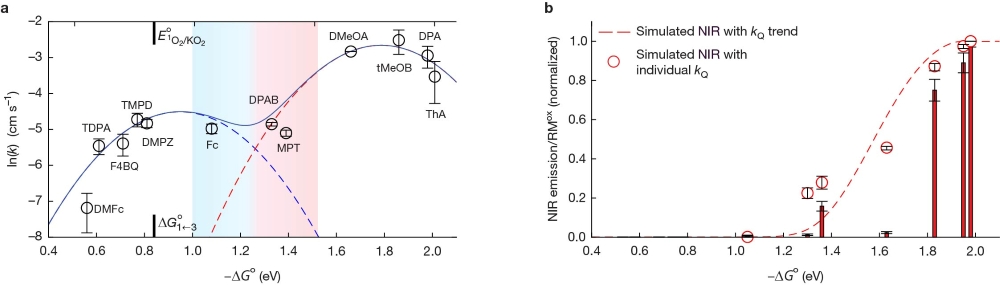
and the 1O2 yields. a, The kinetic constants k for mediated superoxide oxidation in acetonitrile
electrolyte with mediators covering a large range of redox potentials. Plot of versus driving
force . b, Normalized 1270 nm NIR emission (bars), which indicates presence of 1O2. The
dashed line and the circular markers show the simulated NIR emission considering 1O2 formation
and 1O2 quenching by solvent and redox mediator.

