Genetic Dissection of Cerebral Cortex Development
Neuroscience
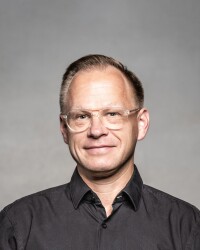
Simon Hippenmeyer
Professor
1 Career
- Since 2019 Professor, Institute of Science and Technology Austria (ISTA)
- 2020 – 2025 Life Sciences Research Area Chair, Institute of Science and Technology Austria (ISTA)
- 2012 – 2019 Assistant Professor, Institute of Science and Technology Austria (ISTA),
- 2006 – 2012 Postdoctoral Fellow (EMBO, HFSP, SNF), Dept. Biology, Stanford University, USA
- 2004 – 2006 Postdoctoral Associate (bridging postdoc), Biozentrum, University of Basel, Switzerland
- 2000 – 2004 PhD (scl), Dept. Cell Biology, Biozentrum, University of Basel, Switzerland
- 1995 – 2000 Diploma (mcl), Dept. Biochemistry, Biozentrum, University of Basel, Switzerland
1.1 Selected Distinctions
- 2026 – 2028 President Austrian Neuroscience Association (ANA), AT
- 2023 – 2027 Co-Organizer EMBO Workshops ‘Neuronal Remodeling’, Nahsholim, IL, Caux, CH
- 2022 – 2025 Society for Neuroscience (SfN) Program Committee, USA
- 2023 Panel Speaker Symposium Dürnstein – Das Gehirn und seine Gesellschaft, AT
- 2016 – 2022 ERC Consolidator Grant (EU Horizon 2020)
1.2 Selected Grants
- 2025 – 2030 FWF Cluster of Excellence (CoE) – Excellent Brains (Co-ordinated by Peter Jonas and Tibor Harkany). € 480,000.
- 2020 – 2028 FWF Special Research Programme (SFB) F78 Stem Cell Modulation (Co-ordinated by Juergen Knoblich). € 788,000.
- 2016 – 2022 European Commission Horizon 2020 – ERC Consolidator Grant. € 2,000,000.
1.3 Tech Transfer (Patents, Spin-Offs)
- MADM Transgenic Reporter Mouse Library Resource. Reporter mouse lines as unique discovery platform, shared freely with the global mouse genetics community, available at ISTA and EMMA (The European Mouse Mutant Archive). https://infrafrontier.eu/emma/. Contreras et al., 2021.
- US Patent 9932607 (14/539’909) – Site-specific Integration of Transgenes in Human Cells
- US Patent 9125385 (13/293’890) – Site-directed Integration of Transgenes in Mammals
1.4 Selected Publications
- Cheung, G.*, Pauler, FM.*, Koppensteiner, P.*, Krausgruber, T., Streicher, C., Schrammel, M., Gutmann-Özgen, N., Ivec, AE., Bock, C., Shigemoto, R. & Hippenmeyer, S. (2024). Multipotent Progenitors Instruct Ontogeny of the Superior Colliculus. Neuron, 112(2):230-246.e11.
- Amberg, N., Pauler, FM., Streicher, C. & Hippenmeyer, S. (2022). Tissue-wide Genetic and Cellular Landscape Shapes the Execution of Sequential PRC2 Functions in Neural Stem Cell Lineage Progression. Science Advances, 8(44), eabq1263.
- Contreras, X., Amberg, N., Davaatseren, M., Hansen, AH., Sonntag, H., Andersen, L., Bernthaler, T., Streicher, C., Heger, A., Johnson, RL., Schwarz, L., Luo, L., Rülicke, T. & Hippenmeyer, S. (2021). A Genome-wide Library of MADM Mice for Single-Cell Genetic Mosaic Analysis. Cell Reports, 35(12):109274.
- Laukoter, S.*, Beattie, R.*, Pauler, FM.*, Amberg, N., Nakayama, KI. & Hippenmeyer, S. (2020). Imprinted Cdkn1c Genomic Locus Cell-Autonomously Promotes Cell Survival in Cerebral Cortex Development. Nature Communications, 11:195.
- Laukoter, S.*, Pauler, FM.*, Beattie, R., Amberg, N., Hansen, AH., Streicher, C., Penz, T., Bock, C. & Hippenmeyer, S. (2020). Cell-Type Specificity of Genomic Imprinting in Cerebral Cortex. Neuron, 107(6):1160-1179.e9.
2 Group Members
- Yuwei Chen, PhD Student since 2026
- Sophie Gobeil, PhD Student since 2023 (co-affiliated with Lora Sweeney)
- Hakan Kücükdereli, Postdoc since 2025
- Osvaldo Miranda, Postdoc since 2025
- Fabrizia Pipicelli, Postdoc since 2023
- Irene Varela Martinez, Postdoc since 2025
- Ana Villalba Requena, Postdoc since 2021
- Florian Pauler, Research Technician since 2016
- Carmen Streicher, Research Technician since 2013
3 Research
The human cerebral cortex is the seat of our cognitive abilities, and composed of an immense number and diversity of neurons and glial cells. The developmental programs regulating the generation of postmitotic neurons, by neural stem cells (NSCs), need to be precisely implemented. Impairments in neurogenesis lead to alterations in the cortical cytoarchitecture which is thought to associate with neurodevelopmental disorders.
The cellular and molecular mechanisms that underlie NSC lineage progression and the generation of cell-type diversity are however mostly unknown. Key questions are: What is the quantitative and qualitative output of a single stem cell and how is the output potential modulated during development? To obtain in-depth insights we probe corticogenesis at unprecedented single cell resolution in vivo by using the unique MADM (Mosaic Analysis with Double Markers) genetic strategy.
The ultimate goal is to establish a definitive quantitative framework and mechanistic model of NSC lineage progression in the developing cerebral cortex, and beyond to assess generalities and specifics in NSCs across distinct brain areas. Advances along our projects shall not only result in a conceptual understanding of the mechanisms generating cell-type diversity, but also allow novel insights into the fundamental question of why human brain development is so sensitive to the disruption of particular signaling pathways in the pathological condition.
3.1 Current Scientific Projects/Directions
- Genetic Dissection of Neural Stem Cell (NSC) Lineage Progression
- Role of Genomic Imprinting in NSC Lineage Progression
- Molecular and Cellular Mechanisms Generating Cell-Type Diversity and Correct Brain Size
- Role of Self-organizing Principles in NSC Lineage Progression
- Generating Bigger Brains – Probing NSC Lineage Progression across Evolution
- Expanding the MADM technology – Human Organoid System and Transgenic Rat Models
3.2 Research in Focus
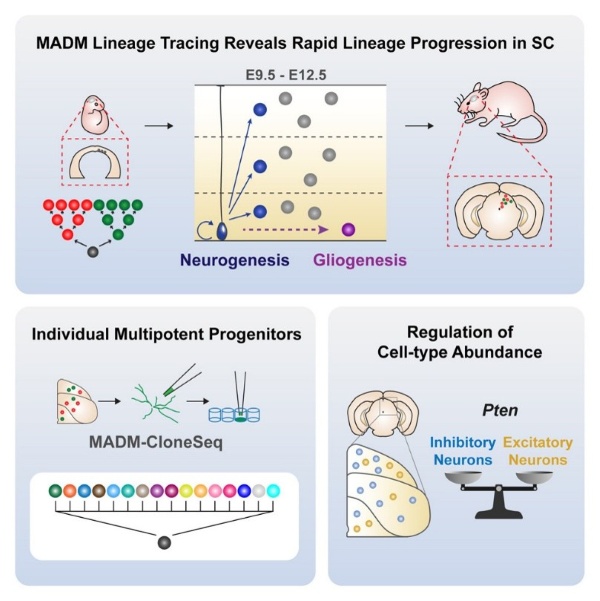
With the aim to decipher the general principles and establish a mechanistic model of neural stem cell (NSC) lineage progression we recently expanded our analysis from the cerebral cortex to the developing superior colliculus (SC). The SC, located in the mammalian midbrain, is organized into distinct laminae and essential for multisensory integration, attention and motor responses. Yet, the cellular principles instructing the ontogeny and the generation of cell-type diversity in the SC remain essentially unexplored. Here we defined the fundamental principles governing radial glial progenitor (RGP) cell lineage progression and the generation of cell-type diversity in the developing SC at true single-progenitor cell resolution. To this end, we also established a novel MADM-CloneSeq approach (Cheung et al., 2024a, STAR Protoc 5(3):103157; Cheung et al., 2024b STAR Protoc 5(3):103168) that enabled the delineation of cell lineages with unprecedented preservation of spatial information in situ, and the transcriptomic cell-type identity of individual clonally-related cells with high clonal coverage (up to 100%), currently unachievable by other techniques like cellular barcoding-based methods.
By systematically reconstructing SC cell lineages, we uncovered that individual SC progenitors are exceptionally multipotent, with the capacity to generate all known SC neuronal cell types without pre-defined fate potential, even until their terminal division. Our findings revealed that all excitatory and inhibitory SC neuronal cell types are generated from individual resident RGPs within the SC. Such finding is in stark contrast to the situations of inhibitory interneurons in other brain regions such as cortex, olfactory bulb or the ventral midbrain. At the mechanistic level, we uncovered an essential role for PTEN signaling in the establishment of appropriate proportions of specific excitatory and inhibitory neuron types in the developing SC.
Altogether, our findings demonstrated not only exceptional multipotency of SC progenitors but also the fundamentals instructing progenitor cell lineage progression in the developing SC. Our data revealed the developmental logic and programs instructing the ontogeny of the SC. More generally, we established a novel framework of the fundamental principles orchestrating the generation of cell-type diversity in SC and the mammalian brain in general (Cheung et al., 2024c, Neuron 112(2):230-246.e11).