
Nonlinear Dynamics and Turbulence
Physics

Björn Hof
Professor
1 Career
- Since 2013 Professor, Institute of Science and Technology Austria (ISTA)
- 2007 – 2013 Max Planck Research Group Leader, MPI-DS, Göttingen, Germany
- 2005 – 2007 Lecturer, Physics, University of Manchester, UK
- 2003 – 2005 Postdoc, TU-Delft, Netherlands
- 2001 PhD, Physics, University of Manchester, UK
1.1 Selected Distinctions
- 2017 Fellow of the American Physical Society
- 2011 Dr. Meyer Struckmann Science Prize
- 2005 RCUK Fellowship
1.2 Selected Grants
- 2023 – 2026 FWF, Hydrodynamic stability of pulsatile flow of complex fluids, awarded to RG: € 319,095.00.
- 2020 – 2023 FWF, Instabilities in pulsating pipe flow in complex fluids, awarded to RG: € 356,301.75.
- 2019 – 2023 Simons Foundation Grant, Revisiting the turbulence problem using statistical mechanics, awarded to RG: € 871,696.73.
1.3 Tech Transfer (Patents, Spin-Offs)
N/A
1.4 Selected Publications
- G. H. Choueiri, J. M. Lopez, A. Varshney, S. Sankar, and B. Hof, “Experimental observation of the origin and structure of elastoinertial turbulence,” Proceedings of the National Academy of Sciences, vol. 118, no. 45, e2102350118, 2021.
- D. Scarselli, J. Lopez, A. Varshney, and B. Hof, “Turbulence suppression by cardiac-cycle-inspired driving of pipe flow,” Nature, vol. 621, no. 7977, pp. 71–74, 2023.
- L. Klotz, G. Lemoult, K. Avila, and B. Hof, “Phase transition to turbulence in spatially extended shear flows,” Physical Review Letters, vol. 128, no. 1, p. 014 502, 2022.
- G. Lemoult et al., “Directed percolation and puff jamming near the transition to pipe turbulence,” Nature Physics, vol. 20, no. 8, pp. 1339–1345, 2024.
- B. Yang, Y. Zhuang, G. Yalnız, V. Mukund, E. Marensi, and B. Hof, “Discontinuous transition to shear flow turbulence,” Nature Physics, pp. 1–6, 2026.
2 Group Members
- Ritwik Das, PhD Student since 2023
- Shoaib Kamil, PhD Student since 2020
- Ziyin Lu, PhD Student since 2022
- Ankit Saha, PhD Student since 2024
- Bowen Yang, PhD Student since 2021
- Baoying Wang, Postdoc since 2023
- Gökhan Yalnız, Postdoc since 2025
- Mukund Vasudevan, Research Technician since 2022
3 Research
Most fluid flows of practical interest are turbulent, yet our understanding of this phenomenon is very limited. The Hof group seeks to gain insight into the nature of turbulence and the dynamics of complex fluids. Flows in oceans, around vehicles, and through pipelines are all highly turbulent. Turbulence governs friction losses and transport and mixing properties. Despite its ubiquity, insights into the nature of turbulence are very limited. To obtain a fundamental understanding of the origin and the principles underlying this phenomenon, the Hof group investigates turbulence when it first arises from smooth, laminar flow. The group combines detailed laboratory experiments with highly resolved computer simulations, and applies methods from nonlinear dynamics and statistical physics, enabling them to decipher key aspects of the transition from smooth to turbulent flow, and identify universal features shared with disordered systems in other areas of physics. Some of these insights can be used to control turbulent flow. In addition, the group investigates instabilities in fluids with more complex properties, such as dense suspensions of particles, polymer solutions and blood flow. Here our present focus is on instabilities in polymeric liquids, where driven by elasticity, novel types of turbulent motion can arise at unusual parameter settings and even approach the zero inertia limit.
3.1 Current Scientific Projects/Directions
- Turbulence without inertia in viscoelastic fluids.
- Stability of pulsatile/cardiovascular flows
- Hydrodynamic stability of quasi Keplerian lows /accretion disks
- Pattern formation and directed percolation in transitional turbulence
3.2 Research in Focus
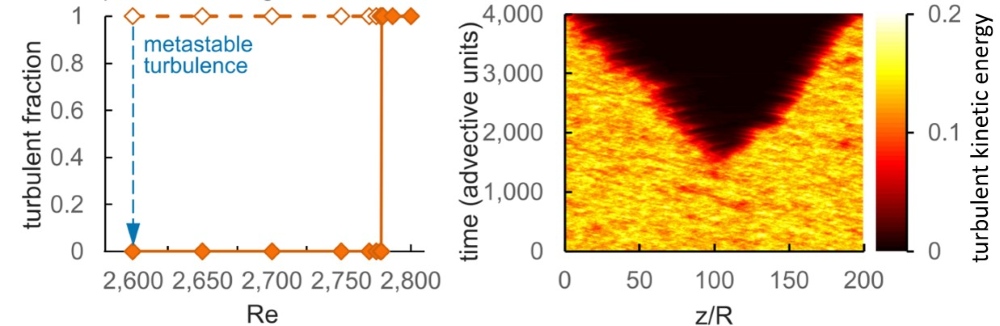
In simple shear flows turbulence first arises locally and the remaining laminar regions are only replaced gradually as the flow speed increases. The resulting co-existence and intermittency are hallmarks of transitional flows in pipes, channels and boundary layers and have been extensively studied for the past century. We recently discovered that this established transition type surprisingly does not account for the more general setting of shear flows subject to body forces. Studying pipe and channel flows subject to some of the most common body forces such as buoyancy, centrifugal forces and Lorenz forces, we find that the transition becomes discontinuous instead. As illustrated in Figure 1, in such cases the equilibrium turbulent fraction discontinuously jumps from zero to one at the critical point. The transition is moreover found to be hysteretic and in the metastable regime the appearance of a laminar seed leads to the rapid demise of turbulence (right panel). The mechanism underlying this unexpected change in the nature of the transition, is a suppression of the energy transport between the laminar and turbulent flow regions. We are presently working on a general criterion that allows to explain at what stage a body force renders the shear flow transition discontinuous.

