Inorganic Materials from Nano to Macro Scales
Chemistry

Maria Ibáñez
VERBUND Professor for Energy Science and Head of the Werner Siemens Thermoelectric Laboratory
1 Career
- Since 2026 Professor, Institute of Science and Technology Austria (ISTA)
- 2018 – 2026 Assistant Professor, Institute of Science and Technology Austria (ISTA)
- 2014 – 2018 Postdoc, ETH Zürich, Switzerland
- 2013 – 2014 Postdoc, Catalonia Energy Research Institute, Spain
- 2013 PhD University of Barcelona, Spain
1.1 Selected Distinctions
- 2023 VERBUND Professor of Energy Science
- 2023 Organizer of the Conference Nanax10, July 03 – 07 , 186 participants, ISTA
- 2021 IAAM Scientist Medal from the International Association of Advanced Materials
- 2021 Organizer of the Chemistry Symposium “Future Directions in Chemistry: From Biology to Advanced Material” (https://www.ist.ac.at/en/news-events/event/?eid=3264), September 29 – 30, ISTA
- 2017 Ružička Prize, an award for the promotion of young scientists in the field of chemistry in Switzerland
1.2 Selected Grants
- 2020 – 2028 Werner Siemens Stiftung (WSS) grant: The Werner Siemens Laboratory for Research on Thermoelectric Materials. Awarded: € 8,000,000.
- 2022 – 2025 HORIZON-EIC-2021-PATHFINDEROPEN-01 (101046742), MeBattery: Mediated Biphasic Battery, Coordinator: E. Ventosa (UBU). Awarded overall: € 2,508,694, awarded to RG: € 385,000.
1.3 Tech Transfer (Patents, Spin-Offs)
Patent (pending): Thermoelectric Device, international patent application filed via the European Patent Office (EPO) under the Patent Cooperation Treaty (PCT), Inventors: M. Ibáñez, S. Xu, and A. Lawal.
PCT/EP2025/072635.
1.4 Selected Publications
- Y. Liu*, T. Kleinhanns, S. Horta, E. P. Dutkiewicz-Kopczynska, S. Lu, M. C. Spadaro, A. Genç, L. Chen, K. H. Lim, M. Hong, J. Arbiol, M. Ibáñez*; Liquid- Solid Interface Reactions Drive Enhanced Thermoelectric Performance in Ag2Se; J. Am. Chem. Soc. 2025, 147, 35, 32199-32208. Available: https://pubs.acs.org/doi/10.1021/jacs.5c11435.
- S. Xu*, S. Horta, A. Lawal, K. Maji, M. Lorion, M. Ibáñez*; Interfacial bonding enhances thermoelectric cooling in 3D-printed materials; Science 2025, 387, 6736, 845-850. Available: https://www.science.org/doi/10.1126/science.ads0426.
- T. Kleinhanns, F. Milillo, M. Calcabrini, C. Fiedler, S. Horta, D. Balazs, M. J. Strumolo, R. Hasler, J. Llorca, M. Tkadletz, R. L. Brutchey, M. Ibáñez*; A Route to High Thermoelectric Performance: Solution-Based Control of Microstructure and Composition in Ag2Se; Adv. Energy Mater. 2024, 14, 22, 2400408. Available: https://advanced.onlinelibrary.wiley.com/doi/10.1002/aenm.202400408.
- Y. Liu, M. Calcabrini, Y. Yu, S. Lee, C. Chang, J. David, T. Ghosh, M. C. Spadaro, C. Xie, O. Cojocaru-Mirédin, J. Arbiol, M. Ibáñez*; Defect Engineering in Solution-Processed Polycrystalline SnSe Leads to High Thermoelectric Performance; ACS Nano 2022, 16, 1, 78–88. Available: https://pubs.acs.org/doi/10.1021/acsnano.1c06720.
- Y. Liu,# M. Calcabrini,# Y. Yu, A. Genç, C. Chang, T. Costanzo, T. Kleinhanns, S. Lee, J. Llorca, O. Cojocaru-Mirédin, M. Ibáñez*; The Importance of Surface Adsorbates in Solution-Processed Thermoelectric Materials: The Case of SnSe; Adv. Mater. 2021, 33, 52, 2106858. Available: https://advanced.onlinelibrary.wiley.com/doi/10.1002/adma.202106858.
2 Group Members
- Christine Fiedler, PhD Student since 2021
- Tobias Kleinhanns, PhD Student since 2020
- Abayomi Lawal, PhD Student since 2024
- Francesco Milillo, PhD Student since 2025
- Aiswarya Rayaroth Puthiyaveettil, PhD Student since 2023
- Ihor Cherniukh, Postdoc since 2024
- Ren He, Postdoc since 2026
- Sharona Horta, Postdoc since 2021
- Navita Jakhar, Postdoc since 2023
- Krishnendu Maji, Postdoc since 2024
- Riddhimoy Pathak, Postdoc since 2026
- Seung Jae Lee, Research Technician since 2026
- Magali Lorion, Research Technician since 2020
3 Research
The properties of materials are ultimately decided at their smallest scales: at defects, interfaces, and boundaries where atoms arrange, reorganize, and interact. These features determine how energy moves through a solid, how catalysts activate, how batteries age, and how devices fail. Yet despite their enormous influence, these structural details remain among the hardest to predict, engineer, and reproduce. Closing the gap between what we can synthesize and what we can actually design is the central challenge our group tries to tackle.
We approach this challenge from two directions simultaneously. We ask fundamental questions about how matter organizes itself: how nanocrystals assemble, how mass redistributes at the nanoscale, how interfaces form and stabilize. And we bring these answers into contact with real problems: developing the chemistry that makes high-performance materials accessible at lower cost, and unlocking architectures, scales, and material combinations that conventional processing cannot reach.
What connects our work is not a single material, technique, or application, but a conviction that deep chemical understanding is the most powerful tool for expanding what is possible and problems we consider most interesting are those that sit precisely at the boundary between fundamental curiosity and genuine utility.
3.1 Current Scientific Projects/Directions
- Understanding surface chemistry in solution synthesis
- Solution-derived thermoelectric materials from nano to macro
- Additive manufacturing of thermoelectric materials
- Fundamentals of nanocrystal structure, stability, and collective behaviour
- Chemically Engineered Interfaces and Architectures for Thermoelectric Materials
- Guided Chemical Space Exploration for Sustainable Thermoelectric Materials
3.2 Research in Focus
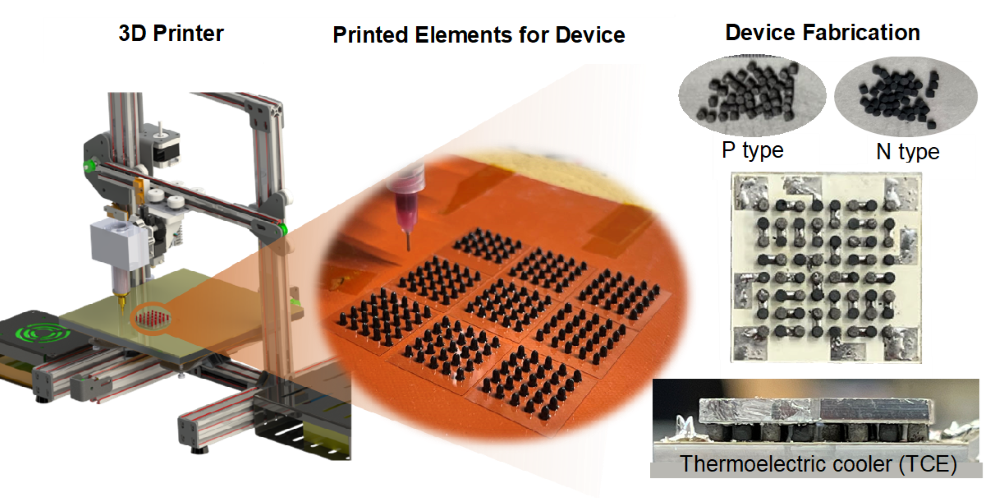
Thermoelectric cooling could replace conventional chemical-based cooling but faces major challenges in scalable, economical device fabrication. Current materials often achieve high performance but are limited because they use expensive precursors, energy-intensive methods, and generate waste. 3D printing offers a promising alternative, though printability often compromises material properties. In this work, we demonstrated that 3D printing could yield record-performing materials and device-ready architectures. By designing inks that promote interfacial bonding through in-situ chemical transformations during sintering, we created well-connected particle networks with extraordinarily low thermal conductivity while retaining high charge mobility. This strategy delivered both n-type (Ag2Se) and p-type ((BiSb)2Te3) based devices with state-of-the-art performance.
Crucially, we translated these advances into functionality at the device level by 3D-printing thermoelectric pillars and assembling a 32-pair cooler that achieved a 50 °C temperature drop. To the best of our knowledge, this was the first demonstration of a thermoelectric cooler built entirely from 3D printed materials. Beyond thermoelectrics, our work established a general methodology for additive manufacturing of functional ceramics, offering a sustainable and scalable route to future electronic materials and devices.
This work was fully done in my group and published in Science: S. Xu et al. Science 2025, 387, 6736, 845-850.