Colloidal and Supramolecular Chemistry
Chemistry

1 Career
- Since 2023 Professor, Institute of Science and Technology Austria (ISTA)
- 2020 – 2023 Professor, Weizmann Institute of Science, Israel
- 2016 – 2020 Associate Professor, Weizmann Institute of Science, Israel
- 2009 – 2015 Assistant Professor (tenure track), Weizmann Institute of Science, Israel
1.1 Selected Distinctions
- 2024 Chair, Gordon Research Conference Systems Chemistry (co-chair: Prof. Rebecca Schulman)
- 2023 Chair, Gordon Research Conference Self-Assembly & Supramolecular Chemistry (co-chair: Prof. Nathalie Katsonis)
- 2019 Sigma–Aldrich Lectureship in Materials Science
- 2019 New Horizons Solvay Lectureship in Chemistry
- 2018 Cram–Lehn–Pedersen Prize in Supramolecular Chemistry
1.2 Selected Grants
- 2019 – 2025 ERC CoG 820008 Dissipative self-assembly in synthetic systems: Towards life-like materials, € 1,999,572.
- 2019 – 2022 Marie Curie Initial Training Network (ITN) Chemical reaction networks: Signal amplification, spatiotemporal control, and materials (with six other PIs), € 527,000 to Klajn.
- 2018 – 2020 US–Israel Binational Science Foundation (Transformative Science program). Metabolic Nanotechnology (Co-PI: Rein V. Ulijn), $150,000 to Klajn.
1.3 Tech Transfer (Patents, Spin-Offs)
N/A
1.4 Selected Publications
- J. Gemen et al., “Ternary host-guest complexes with rapid exchange kinetics and photoswitchable fluorescence”, Chem, vol. 8, no. 9, pp. 2362–2379, September 2022, issn: 2451-9294. https://doi.org/10.1016/j.chempr.2022.05.008.
- J. Cai et al., “Polarization-sensitive optoionic membranes from chiral plasmonic nanoparticles”, Nature Nanotechnology, vol. 17, no. 3, pp. 408–416, March 2022, issn: 1748-3395. https://doi.org/10.1038/s41565-022-01079-3.
- T. Bian et al., “Electrostatic co-assembly of nanoparticles with oppositely charged small molecules into static and dynamic superstructures”, Nature Chemistry, vol. 13, no. 10, pp. 940–949, October 2021, issn: 1755-4330. https://doi.org/10.1038/s41557-021-00752-9.
- J. Gemen et al., “Disequilibrating azobenzenes by visible-light sensitization under confinement”, Science, vol. 381, no. 6664, pp. 1357–1363, September 2023, issn: 0036-8075. https://doi.org/10.1126/science.adh9059.
- K. Hema et al., “Guest Encapsulation Alters the Thermodynamic Landscape of a Coordination Host” Journal of the American Chemical Society, vol. 145, no. 45, pp. 24755–24764, November 2023, issn: 1520-5126. https://doi.org/10.1021/jacs.3c08666.
2 Group Members
- Longyu Guang, PhD Student since 2025
- Gayathri Palissery, PhD Student since 2025
- Ting Zhang, PhD Student since 2026
- Cyprien Muller, Postdoc since 2025
- Carlo Rigoni, Postdoc since 2024
- Sumit Roy, Postdoc since 2024
- Promeet Saha, Postdoc since 2024
- Kyle Chardi, Research Technician since 2024
3 Research
We are interested in the fundamental issue of chemical reactivity under confinement. We investigate the behavior of chemical species within various types of nanoconfined environments, including surfaces of colloidal nanoparticles, cavities within coordination cages, and nanopores within porous materials. We also develop novel families of synthetic materials featuring confined spaces; examples include reversibly self-assembling colloidal crystals and bowl-shaped metallic nanoparticles.
The second line of our research focuses on elucidating the principles of self-assembly at the nanoscale. We study how nanoscopic particles interact with each other, with the ultimate goal of creating functional nanomaterials with specific properties. We have recently demonstrated that the combination of short- and long-range forces of different symmetries can guide the self-assembly of structurally simple building blocks into frustrated structures with intriguing optical properties.
Finally, we design new synthetic systems capable of dissipative self-assembly – a process ubiquitous in nature that gives rise to complex structures and properties such as self-healing, homeostasis, and camouflage. To this end, we employ novel, unconventional approaches that integrate organic and nanoparticulated building blocks into hybrid structures that can be programmed to self-assemble into larger structures and, ultimately, energy-efficient and environmentally friendly materials.
3.1 Current Scientific Projects/Directions
- Colloidal synthesis and self-assembly of nanocrystals with various sizes, shapes, chemical compositions, and surface chemistries
- New hybrid organic–inorganic functional materials
- “Green” supramolecular triplet energy transfer catalysis
- Controlling the structure and function of supramolecular cages by ancillary ligand engineering
- Photoconductive nonpolar fluids based on azobenzene
3.2 Research in Focus
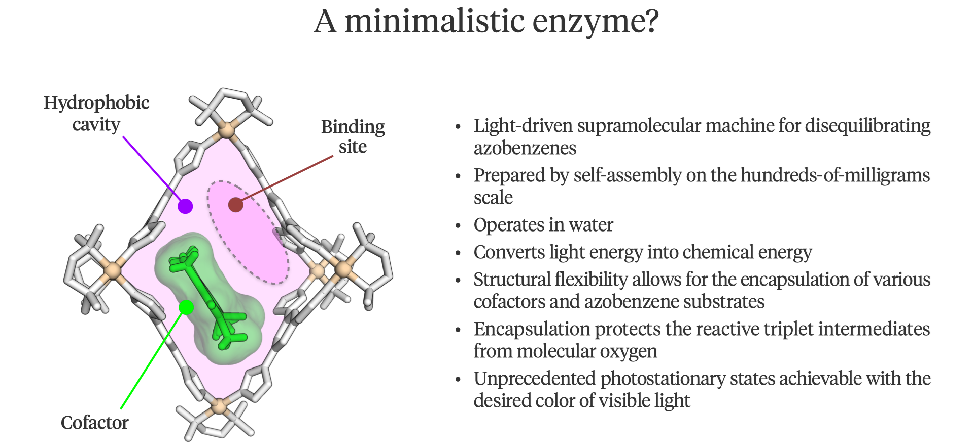
Nature has long impressed chemists with its ability to stabilize ephemeral chemical species, perform reactions with unprecedented rates and selectivities, and synthesize complex organic molecules and exquisite inorganic structures seemingly effortlessly. What the natural systems consistently exploit is the aspect of confinement. In contrast, the use of confinement effects in synthetic systems remains rare. We have recently developed a methodology called disequilibration by sensitization under confinement (DESC) – a supramolecular approach to isomerize photoswitchable molecules from a stable state to a metastable state using visible light of the desired wavelength (including red light). To this end, we designed a supramolecular host–guest inclusion complex that functions as an azobenzene photoisomerase. This “artificial enzyme” can selectively bind and sensitize the E isomer of various azobenzenes and other azo switches. When switched to the metastable Z isomer, the azoarene loses its affinity for—and is expelled from—the cage, which can then transform additional copies of E into Z. In this way, the cage/sensitizer complex acts as a light-driven supramolecular machine converting light energy into chemical energy in the form of out-of-equilibrium photostationary states that cannot be accessed directly with visible light. This work was published in Nature Materials: J. Gemen et al., Science 381, 1357–1363 (2023).