
Thermodynamics of Quantum Materials at the Microscale
Physics

Kimberly Modic
Assistant Professor
1 Career
- Since 2020 Professor, Institute of Science and Technology Austria (ISTA)
- 2016 – 2019 Postdoctoral Researcher, Max Planck Institute for Chemical Physics of Solids, Dresden, Germany
- 2012 – 2016 Graduate Researcher, National High Magnetic Field Laboratory, Los Alamos, USA
- 2009 – 2015 PhD in Physics, University of Texas at Austin, USA
- 2005 – 2009 BSc in Physics, Clemson University, USA
1.1 Selected Distinctions
- 2024 Member of the Young Austrian Academy of Sciences ( ÖAW)
- 2020 – 2025 Member of the Elisabeth Schiemann Kolleg
1.2 Selected Grants
- 2023 – 2028 ERC Starting Grant: Gaining leverage with spin liquids and topological superconductors, € 2,324,880.
- 2022 – 2025 FWF Stand-alone Grant: Unraveling the mysteries of 1T-TaS2, € 404,278.
- 2022 – 2027 SFB Correlated Quantum Materials & Solid State Quantum Systems, € 276,629.
1.3 Tech Transfer (Patents, Spin-Offs)
N/A
1.4 Selected Publications
- V. Zambra, A. Nathwani, M. Nauman, S. K. Lewin, C. E. Frank, N. P. Butch, A. Shekhter, B. J. Ramshaw, K. A. Modic. Giant transverse magnetic fluctuations at the edge of re-entrant superconductivity in . In print at Nature Communications (2026).
- T Sato, B. J. Ramshaw, K. A. Modic, F. F. Assaad. Scale-invariant magnetic anisotropy in α-RuCl3: A quantum Monte Carlo study. Physical Review B 110(20), L201114 (2024).
- S. Safari, W. Bateman-Hemphill, A. Mitra, F. Desrochers, E. Z. Zhang, L. Shafeek, A. Ferrenti, T. M. McQueen, A. Shekhter, Z. Köllö, Y. B. Kim, B. J. Ramshaw, K. A. Modic. Quantum fluctuations suppress the critical fields in BaCo2(AsO4)2. arXiv:2403.15315 (2024).
- A. Shekhter, R. D. McDonald, B. J. Ramshaw, K. A. Modic. Magnetotropic susceptibility.
Physical Review B 108, 035111 (2023). - K. A. Modic et al. Scale-invariant magnetic anisotropy in α-RuCl3 at high magnetic fields. Nature Physics 17, 240–244 (2021).
2 Group Members
- Nasriddin Djienbekov, PhD Student since 2026
- Frantisek Jerabek, PhD Student since 2026
- Hamza Nasir, PhD Student since 2023
- Gulnaz Rakhmanova, PhD Student since 2021
- Shiva Safari, PhD Student since 202
- Valeska Zambra, PhD Student since 2021
- Lucas Correa, Postdoc since 2025
- Akash Khansili, Postdoc since 2025
- Vikram Nagarajan, Postdoc since 2024
- Zoltan Köllö, Research Technician since 2020
3 Research
Modern technology is rooted in our ability to understand and control the quantum behavior of electrons in materials. Today, this effort is entering a new phase, as researchers explore quantum materials whose collective electronic properties give rise to entirely new phenomena, with the long-term goal of enabling future quantum technologies. In these systems, strong interactions lead to emergent states such as unconventional superconductivity, quantum spin liquids, and non-Fermi liquid behavior. Understanding these phases requires accessing regimes where quantum effects dominate and conventional probes are often insufficient. Our research focuses on measuring and interpreting fundamental properties of quantum materials under extreme conditions. In particular, we use high magnetic fields as a powerful tuning parameter to suppress competing phases and reveal hidden states, combined with ultra-low temperatures and high-precision measurements. To open new windows into the complexity of quantum materials, we develop novel experimental techniques, including thermodynamic probes such as the magnetotropic susceptibility and pulsed-echo ultrasound on micron-scale samples, which are sensitive to broken symmetries and dissipation arising from exotic excitations, such as Majorana fermions in quantum spin liquids. These approaches enable us to uncover new phases of matter and identify the microscopic mechanisms governing complex, macroscopic phenomena. Our goal is to establish general principles of quantum matter that provide a solid foundation for future quantum technologies.
3.1 Current Scientific Projects/Directions
- High magnetic field studies of quantum spin liquids and topological superconductors
- Magnetotropic susceptibility as a probe of quantum criticality
- Pulsed echo ultrasound techniques for micron-scale samples
3.2 Research in Focus
Understanding and controlling quantum materials is a central challenge in condensed matter physics, particularly in systems where strong interactions give rise to their exotic and potentially-useful properties. A major difficulty is that many of the key properties of these systems—such as symmetry breaking, anisotropy, and low-energy excitations—are not directly accessible with conventional experimental probes.
Towards this effort, a key contribution of our group has been the discovery and implementation of magnetotropic susceptibility as a new thermodynamic probe of quantum materials [4]. This quantity provides direct access to anisotropic magnetic and dissipative responses, enabling the detection of subtle phase transitions and offering a unique link to the microscopic interactions.
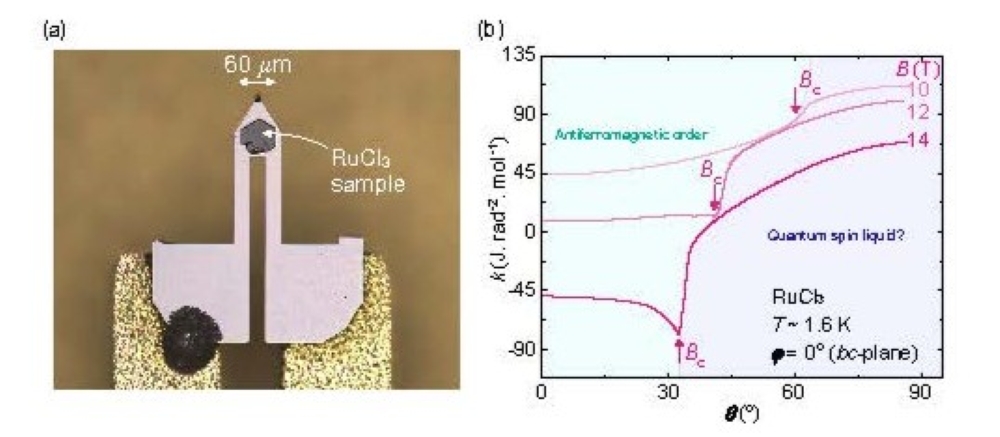
Using this approach, we studied the Kitaev material α-RuCl3 in high magnetic fields (Figure 1) and observed scale-invariant behavior in an unexpected regime—a new phenomenon in a frustrated quantum spin system [5]. By combining precision measurements with theoretical modeling, we identified the key microscopic interactions responsible for its emergence [2]. We are now exploring the universality of this behavior in other frustrated quantum magnets to determine whether it can serve as a distinct signature of a proximate Kitaev quantum spin liquid [3].
We further applied this technique to the unconventional superconductor UTe2, where it uniquely probes the transverse magnetic susceptibility [1]. Our measurements revealed giant transverse fluctuations surrounding the region of re-entrant superconductivity, identifying a likely mechanism for its high-field superconductivity and providing strong evidence for spin-triplet pairing. These results demonstrate how new thermodynamic probes can reveal previously hidden aspects of quantum materials.

