
Materiali Molli Lab
Physics

Jérémie Palacci
Professor
1 Career
- Since 2023 Professor, Institute of Science and Technology Austria (ISTA)
- 2021 – 2023 Assistant Professor, Institute of Science and Technology Austria (ISTA)
- 2021 – 2023 Adjunct Associate Professor, University of California San Diego, La Jolla, CA, USA
- 2020 – 2021 Associate Professor (with tenure) University of California San Diego, La Jolla, CA, USA
- 2015 – 2020 Assistant Professor, tenure-track, University of California San Diego, La Jolla, CA, USA
- 2010 – 2014 Postdoc, Center for Soft Matter Research, New York University, USA
- 2010 PhD, Université de Lyon, Lyon I, France
1.1 Selected Distinctions
- 2023 ERC consolidator recipient
- 2020 – 2021 Invited Professor Ecole Normale Superieure (Paris, France- 9 months)
- 2020 Total invited Chair (ESPCI, Paris, France- 1 month)
- 2017 Sloan Fellow in Physics
1.2 Selected Grants
- 2023 – 2028 ERC Consolidator (PE3), “Vulcan, Matter Powered from within” (€ 2M), single PI (awarded ISTA).
- 2022 – 2025 US Army Research Office, “Emergent Phenomena in Collection of Autonomous Spinning Microgears Guided by Light” ($ 264K), single PI (awarded ISTA).
- 2016 – 2022 NSF Career Award “Emergent Properties in Synthetic Active Matter: self organization and synchronization” ($ 645K), single PI (awarded to UCSD).
1.3 Tech Transfer (Patents, Spin-Offs)
N/A
1.4 Selected Publications
- “The hydrodynamic torque dipole from rotarybacterial flagella powers symmetric discs“, D. Grober, T. Dhar, D. Saintillan, J. Palacci, Nature Physics, 22, 2026.
- “Emergent Dynamics of Active Elastic Microbeams”, Q. Martinet, Y. Li, A Aubret, E. Hannezo, J. Palacci, PRX, 15, 2025.
- “Characterization of Catalytic MicroswimmersUsing PhoreticallyResponsive Nanotracers”,C. Carrasco, Q. Martinet, Z. Shen, J. Lintuvuori, J. Palacci, A. Aubret, ACS Nano, 19, 2025.
- “Unconventional colloidal aggregation in bacterial baths”, D. Grober, I. Palaia, M. Can Ucar, E. Hannezo, A. Saric, J. Palacci, Nature Physics, 19, 2023.
- “Metamachines of Pluripotent Colloids”, A. Aubret, Q. Martinet, J. Palacci, Nature Comm., 12, 2021.
2 Group Members
- Samuel Hayek, PhD Student since 2023
- Jinyu Li, PhD Student since 2025
- Irina-Malina Strugaru, PhD Student since 2023
- Nicolas Fares, Postdoc since 2026
- Stéphane Guillet, Postdoc since 2024
- Raushan Kant, Postdoc since 2025
- Quentin Martinet, Postdoc since 2021
3 Research
TheMaterialiMolli Lab focuses on using activityas a design principle for materials and self-assembly—turning non-equilibrium physics into a lever to program matter and structures. We aim to establish a new paradigm where materials are not passive but adaptive, self-driven, and programmable, bridging soft matter physics, robotics, and living matter.
The group’s central theme is “materials powered from within”: embedding energy-consuming units (active colloids, bacteria, or responsive materials) into soft matter to control structure, dynamics, and function in real time. An important pillar of the research program is programmable self-assembly and “metamachines”and we have shown that active colloids can be the building blocks of functional architectures. This establishes the concept of metamachines or machines made of machines and lays the groundwork for the study of active solids at the microscale. Alternatively, we use the activity of swimming bacteria to control the assembly of passive building blocks, effectively making bacteria the blacksmiths of unconventional colloidal gels. We are expanding the 2D proof of concept using optogenetic bacteria, whose velocity is controlled externally by light, to program in time and space and in 3D. Finally, we have recently developed a direction in soft robotics, whereby liquid crystal elastomers are programmed into soft robots by using the interplay between macroscopic cuts and molecular order.
3.1 Current Scientific Projects/Directions
- Bacteria as blacksmiths – unconventional gels controlled by activity
- Chiral fluids
- Active colloidal solids
- Colloidal Metamachines
- Colloidal design and synchronization
- Kirigami Liquid crystal elastomers
3.2 Research in Focus
Vulcan, the Roman god of blacksmithing, was revered in Europe since the Iron Age (1200-500 BC) for a powerful skill: controlling the macroscopic properties of metals (strength, ductility, toughness). To this day, thermal treatments such as annealing – cycles of high temperatures, alternated with slow cooling – remain an essential tool of material science but are out of touch for soft materials that burn at such temperature.Instead, we proposed for paradigm to use the activity of the suspending fluid (as a proxy for “temperature”) to control and assemble colloidal gels, and establish bacteria as blacksmiths. We showed that swimming E. Colibacteria constitute an active chiral bath that controls the assembly of unconventional aggregates. This is a powerful concept and a novel approach to design and program matter. We are pushing it further using optogenetic bacteria, whose activity is controlled in time and space by light and developing novel approach for 3D gels, with bespoke mechanical properties, to become the architect of matter. This is an impactful, novel and original direction of research, tearing down the boundary between active matter and materials science, and a source of inspiration for the field at large.
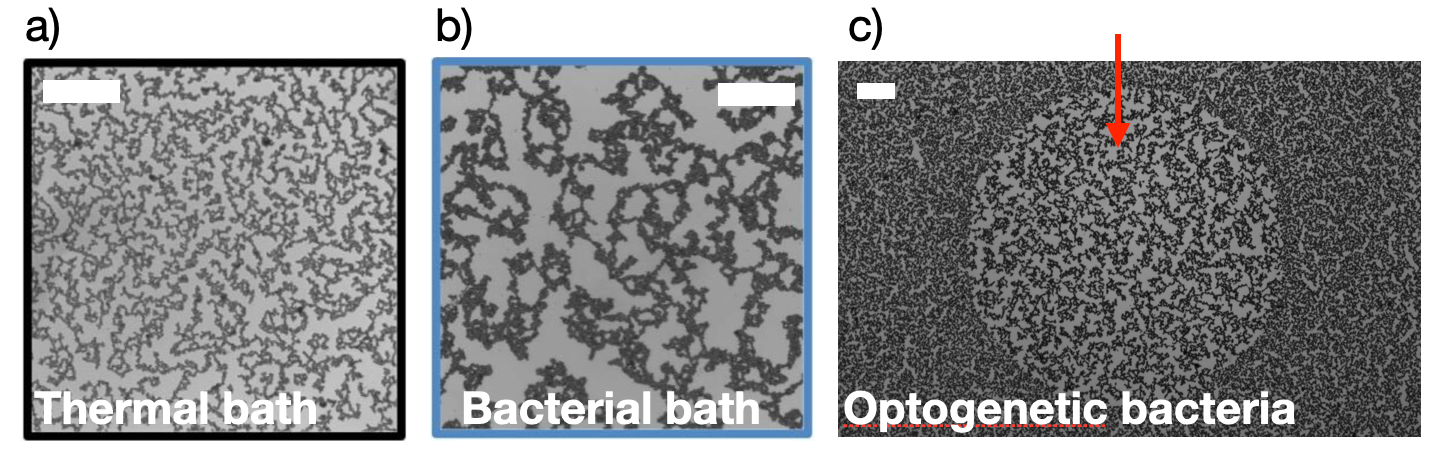
Sources: [Grober et al, Nature Phys. 2023], [Grober et al, Nature Phys. 2026], [Guillet et al, in prep].

