
Emergent Electronic Phenomena in 2D Materials
Physics

Hryhoriy Polshyn
Assistant Professor
1 Career
- Since 2022 Assistant Professor, Institute of Science and Technology Austria (ISTA)
- 2017 – 2022 Postdoctoral Scholar, University of California, Santa Barbara, USA
- 2017 PhD, University of Illinois Urbana-Champaign, USA
- 2007 – 2009 Research Assistant, Institute of Metal Physics of NASU, Kyiv, Ukraine
1.1 Selected Distinctions
- Since 2024 Elected member of the Young Academy of the Austrian Academy of Sciences (ÖAW)
- 2016 Jordan S. Asketh Fellowship
1.2 Selected Grants
- 2024 – 2029 ERC-2023-STG (101118064). Orbital Chern Insulators in van der Waals Moiré Systems. Award : € 1,831,500.
1.3 Tech Transfer (Patents, Spin-Offs)
N/A
1.4 Selected Publications
- H. Polshyn et al., “Topological charge density waves at half-integer filling of a moiré superlattice,” Nature Physics, vol. 18, no. 1, pp. 42–47, Dec. 2021, issn: 1745-2481. DOI: 10.1038/s41567-021-01418-6. [Online]. Available: http://dx.doi.org/10.1038/s41567-021-01418-6.
- C. L. Tschirhart et al., “Imaging orbital ferromagnetism in a moiré Chern insulator,” Science, vol. 372, no. 6548, pp. 1323–1327, May 2021, issn: 1095-9203. DOI: 10.1126/science.abd3190. [Online]. Available: http://dx.doi.org/10.1126/science.abd3190.
- H. Polshyn et al., “Electrical switching of magnetic order in an orbital Chern insulator,” Nature, vol. 588, no. 7836, pp. 66–70, Nov. 2020, issn: 1476-4687. DOI: 10.1038/s41586-020-2963-8. [Online]. Available: http://dx.doi.org/10.1038/s41586-020-2963-8.
- M. Serlin et al., “Intrinsic quantized anomalous Hall effect in a moiré heterostructure,” Science, vol. 367, no. 6480, pp. 900–903, Dec. 2019, issn: 1095-9203. DOI: 10.1126/science.aay5533. [Online]. Available: http://dx.doi.org/10.1126/science.aay5533.
- H. Polshyn et al., “Large linear-in-temperature resistivity in twisted bilayer graphene,” Nature Physics, vol. 15, no. 10, pp. 1011–1016, Aug. 2019, issn: 1745-2481. DOI: 10.1038/s41567-019-0596-3. [Online]. Available: http://dx.doi.org/10.1038/s41567-019-0596-3.
2 Group Members
- Vignesh Asokan, PhD Student since 2026
- Mingyu Hao, PhD Student since 2025
- Nikita Kuzmin, PhD Student since 2025
- Shreyasi Das, Postdoc since 2024
- Maosen Qin, Postdoc since 2023
3 Research
Electrons confined to two dimensions can behave in unique and fascinating ways. For example, in certain 2D materials, the quantum mechanical motion of electrons can give rise to striking collective behavior. These emergent, strongly correlated electronic states can exhibit topological order, superconductivity, magnetism, and other forms of electronic order. Our group’s research aims to answer fundamental questions about these exotic states while also establishing the physical foundation for conceptually new electronic devices and qubits.
Graphene and other van der Waals (vdW) materials offer exciting opportunities to create new strongly correlated 2D electronic systems. By combining atomically thin crystals of these materials in different ways, one can efficiently tune the strength and nature of electronic interactions. Our group uses advanced nanofabrication techniques to create clean, highly tunable devices based on vdW materials. We currently focus on graphene multilayers, where rhombohedral stacking or small rotational misalignments between layers can produce extremely flat electronic bands that enhance strong electronic correlations. Such systems have recently been shown to host unconventional superconductivity and topological electronic phases in which electrons can flow along the sample edge without dissipation. We employ ultra-low-temperature electronic transport measurements and scanning probe microscopy to uncover the physics of these novel electronic states.
3.1 Current Scientific Projects/Directions
- Electronic transport properties of quantum anomalous Hall edge states and domain walls.
- Probing the mechanisms of superconductivity in rhombohedral graphene multilayers.
- Investigation of quantum anomalous Hall states using low-temperature scanning probe microscopy.
3.2 Research in Focus
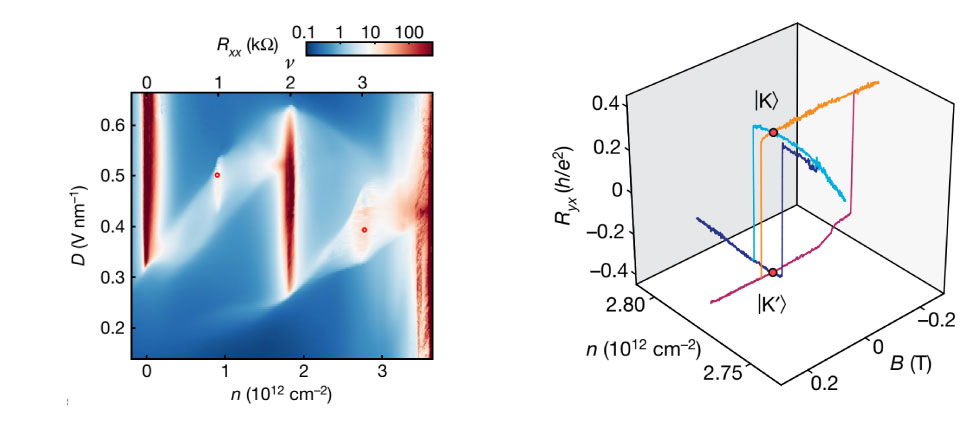
Strong electronic interactions in the flat bands of graphene multilayers with moiré superlattices can produce topological states with net valley polarization, leading to magnetism of predominantly orbital rather than spin origin. This distinguishes these systems from conventional magnets, whose magnetism is usually dominated by electron spin. A notable consequence is that the orbital magnetization can be tuned continuously and even reversed by electrical gating. In this work, we introduced a new system, twisted monolayer–bilayer graphene, and used it to demonstrate that orbital magnetization enables nonvolatile electrical switching between magnetic states. These states can be directly identified through the sign of the quantized Hall resistance, making them attractive for potential applications. This result establishes a new route for the electrical control and readout of magnetic states in graphene-based moiré systems, with possible longer-term relevance for low-power magnetic memory and devices based on reconfigurable edge states. Publication: H. Polshyn et al., Nature 588, 66 (2020).

