Structural Biology of Membrane Protein Complexes
Biology

Leonid Sazanov
Professor
1 Career
- Since 2015 Professor, Institute of Science and Technology Austria (ISTA)
- 2000 – 2015 Group and Program Leader, MRC Mitochondrial Biology Unit, Cambridge, UK
- 1997 – 2000 Research Associate, MRC Laboratory of Molecular Biology, Cambridge, UK
- 1994 – 1997 Research Fellow, Imperial College, London, UK
- 1992 – 1994 Postdoc, University of Birmingham, UK
- 1990 – 1992 Postdoc, Belozersky Institute of Physico-chemical Biology, Moscow State University, Russia
1.1 Selected Distinctions
- 2024 Erwin Schroedinger Award, Austrian Academy of Sciences
- 2023 Lower Austria Science prize
- 2022 Keilin Memorial Medal and Lecture
- 2019 Elected Fellow of the Royal Society
- 2018 Elected EMBO member
1.2 Selected Grants
- 2023 – 2028 Founding member of the Board of Directors of Austria’s Cluster of Excellence “Microbiomes Drive Planetary Health”. Awarded overall € 35,000,000; RG: € 630,000.
- 2021 – 2026 Structure and mechanism of respiratory chain molecular machines; H2020 – ERC Advanced Grant; €1,781,133.
- 2022 – 2025 Mitochondrial Complex I as a Target for Neuroprotection in AD; NIH- R01; €293,142.
1.3 Tech Transfer (Patents, Spin-Offs)
N/A
1.4 Selected Publications
- Kampjut, D. and L.A. Sazanov, “Structure and mechanism of mitochondrial proton-translocating transhydrogenase”. Nature, 2019. 573: p. 291-295. DOI: 10.1038/s41586-019-1519-2.
- Kampjut, D. and L.A. Sazanov, “The coupling mechanism of mammalian respiratory complex I”. Science, 2020. 370(6516). DOI: 10.1126/science.abc4209.
- Vercellino, I. and L.A. Sazanov, “Structure and assembly of the mammalian mitochondrial supercomplex CIII(2)CIV”. Nature, 2021. 598(7880): p. 364-367. DOI: 10.1038/s41586-021-03927-z.
- Kravchuk, V., O. Petrova, D. Kampjut, A. Wojciechowska-Bason, Z. Breese, and L. Sazanov, “A universal coupling mechanism of respiratory complex I”. Nature, 2022. 609(7928): p. 808-814. DOI: 10.1038/s41586-022-05199-7.
- Vercellino, I. and L.A. Sazanov, “SCAF1 drives the compositional diversity of mammalian respirasomes”. Nature Struct. Mol. Biol., 2024. 31(7): p. 1061-1071. DOI: 10.1038/s41594-024-01255-0.
2 Group Members
- Andy Dominguez Rodriguez, PhD Student since 2024
- Serhat Donmez, PhD Student since 2024
- Anton Kavaleuski, PhD Student since 2022
- Jakob Andersson, Postdoc since 2023
- Kaitlyn Kiernan, Postdoc since 2025
- Aleksandra Kulikova, Postdoc since 2023
- Olga Petrova, Postdoc since 2020
- Ning Wang, Postdoc since 2024
- Ziyu Zhao, Postdoc since 2023
- Alexej Charnagalov, Research Technician since 2016
3 Research
We investigate the fundamental mechanistic principles of bioenergetic membrane protein complexes, with a primary focus on the structure and function of respiratory enzymes, particularly complex I. Having determined the atomic structures of key respiratory chain components—including bacterial and mammalian complex I, respiratory supercomplexes, transhydrogenase, and ATP synthase—we continue to study these systems primarily through cryo-electron microscopy (cryo-EM) and diverse functional assays. These structural and functional data allow us to develop a comprehensive mechanistic understanding of these elaborate molecular machines. This knowledge further contributes to drug development efforts, particularly as mitochondrial diseases are among the most common human disorders.
Our current research includes further elucidation of the coupling mechanism of complex I. We utilize cryo-EM to study enzymes from various species incorporated into proteoliposomes or submitochondrial particles, revealing fundamental common features under near-physiological conditions in the presence of a proton-motive force (PMF). As the full repertoire of mitochondrial supercomplexes remains to be defined, we continue to discover new types of these assemblies, including recent structures of novel respirasomes, thereby improving our understanding of OXPHOS organization. We also address the hotly debated role of ATP synthase in permeability transition pore (PTP) opening from a structural perspective, combining cryo-EM with mutagenesis and functional studies. Additionally, we are investigating the active Tat system to unravel the ‘mystery’ of how it achieves the translocation of fully folded proteins without disrupting the membrane. Finally, we collaborate with international research groups in the USA, Japan, and beyond to develop Complex I-targeting drug candidates for Alzheimer’s and other neurodegenerative diseases.
3.1 Current Scientific Projects/Directions
- Structural and functional studies on the coupling mechanism of respiratory complex I.
- Inhibitors of complex I as drug candidates.
- Structure and function of mitochondrial respiratory supercomplexes.
- ATP synthase structure/mechanism and mitochondrial Permeability Transition Pore (PTP).
- Structure and mechanism of protein import via TAT translocase complex.
- Structures of novel bioenergetic complexes from the comammox bacterium Nitrospira inopinata.
3.2 Research in Focus
The vast complexity of respiratory complex I, which belies its efficiency, is one of nature’s most intriguing wonders. The complex comprises up to 45 different subunits with the total molecular weight of about 1 MDa. The redox energy of NADH, released upon binding at the tip of the hydrophilic domain, is eventually utilized in the membrane domain at distances of up to ~300 Å. Electron transfer events in the hydrophilic domain are tightly coupled to proton translocation across the membrane domain. However, the exact coupling mechanism has remained an enigma—a question that has occupied the research community for nearly 50 years.
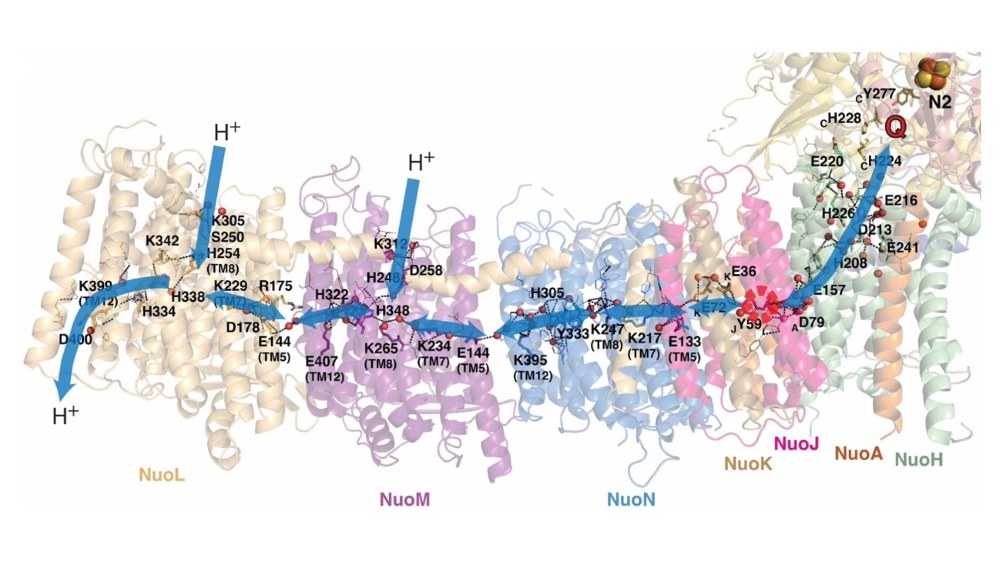
We have solved 21 different cryo-EM structures of mammalian complex I under five different conditions, including active catalytic turnover. The very high resolutions achieved (up to 2.3 Å) allowed for the visualization of the entire water molecule network, which is key to understanding proton translocation events. Surprisingly, the structures revealed that instead of the four independent proton channels previously assumed, there is only one common exit for protons pumped into the intermembrane space.
A comparison and analysis of these structures allowed us to propose the first detailed mechanism of Complex I, involving an unexpected combination of conformational changes around the quinone-binding site, electrostatic interactions, and the lateral movement of protons along the membrane domain. Recently, we refined this mechanism based on several bacterial enzyme structures, arriving at a universally conserved mechanism for Complex I. While this work overturned many long-standing assumptions in the field, the newly proposed mechanism is highly robust and explains all the unusual features of the Complex I architecture. This research was published in Science (2020) and Nature (2022).