Single-Molecule Physics and Chemistry
Chemistry

Latha Venkataraman
Professor
1 Career
- Since 2025 Professor, Institute of Science and Technology Austria (ISTA)
- 2019 – 2024 Lawrence Gussman Professor of Applied Physics, Columbia University, USA
- 2019 – 2022 Vice Provost for Faculty Affairs, Columbia University, USA
- 2016 – 2024 Professor of Chemistry, Columbia University, USA
- 2016 – 2019 Professor of Applied Physics, Columbia University, USA
- 2012 – 2026 Associate Professor of Applied Physics (tenured), Columbia University, USA
- 2011 – 2012 Associate Professor of Applied Physics, Columbia University, USA
- 2007 – 2011 Assistant Professor of Applied Physics, Columbia University, USA
- 2003 – 2007 Research Scientist, Columbia University, USA
- 1999 – 2003 Research Scientist, Vytran Corporation, USA
1.1 Selected Distinctions
- 2023 Alexander von Humboldt Research Award
- 2015 Fellow, American Physical Society
- 2011 Alfred P. Sloan Research Fellowship
- 2008 Packard Fellowship in Science and Engineering
1.2 Selected Grants
- 2023 – 2026 National Science Foundation DMR, USD 450,000.
- 2021 – 2024 Materials Science and Engineering Center, USD 300,000.
- 2021 – 2024 CCI Phase I Center NSF CHE, USD 1,800,000.
- 2021 – 2025 Binational Science Foundation Israel, USD 216,000.
- 2020 – 2023 Office of Naval Research, USD 600,000.
- 2018 – 2022 National Science Foundation CHE, USD 450,000.
- 2018 – 2022 National Science Foundation CHE, USD 530,000.
- 2018 – 2021 National Science Foundation CHE, USD 580,000.
1.3 Tech Transfer (Patents, Spin-Offs)
N/A
1.4 Selected Publications
- E. York, I. Stone, W. Shi, X. Roy, L. Venkataraman, Tuning Conductance in BODIPY-based Single Molecule Junctions, Nano Letters 25, 36, 1369713702 (2025).
- W. Shi, M. Wang, L. Venkataraman, J.D. Tovar, Single-Molecule Conductance through Hybrid Radially and Linearly π-Conjugated Macromolecules Reveals an Unusual Intramolecular π-Interaction, Nano Letters vol. 25, 31, 1210112106 (2025).
- L.Li, W. Shi, A. Mahajan, J. Zhang, M. Gmez-Gmez, J. Labella, S. Louie, T. Torres, S. Bar- low, S.R. Marder, D.R. Reichman, L. Venkataraman, Too Fast for Spin Flipping: Absence of Chirality-Induced Spin Selectivity in Coherent Electron Transport through Single-Molecule Junctions, JACS vol. 147, 28, 2504325051(2025).
- W. Lee, L. Li, M. Camarasa-Gómez, D. Hernangómez-Pérez, X. Roy, F. Evers, M.S. Inkpen, L. Venkataraman*, Photooxidation Driven Formation of Fe-Au Linked Ferrocene-Based Single-Molecule Junctions, Nature Communications, 15, Article 1439 (2024).
- L. Li, J. Low, J. Wilhelm, G. Liao, S. Gunasekaran, C. Prindle, R. Starr, D. Golze, C. Nuckolls, M.L. Steigerwald, F. Evers, L. Campos, X. Yin, L. Venkataraman, Highly Conducting Single Molecule Topological Insulators Based on Mono- and Di-Radical Cations, Nature Chemistry Vol. 14, p. 10611067 (2022).
2 Group Members
- Artem Gulyaev, PhD Student
- Jyotisman Hazarika, PhD Student
- Junfeng Lin, Postdoc
- Parna Roy, Postdoc
- Rahul Meena, Research Technician
3 Research
My group has developed a strong research program in the field of molecular electronics with the aims of understanding matter at the nanoscale through an interdisciplinary approach that combines physics, chemistry and engineering. My lab is a leader in probing, manipulating and controlling single molecules as active elements of circuits, understanding the electronic, mechanical, optical and thermoelectric properties of devices that achieve the smallest possible (i.e., atomic) dimensions. We collaborate with synthetic chemists and theoretical physicists to understand how our experimental findings can be related to fundamental chemical structures and theoretical models. Besides advancing the field known broadly as molecular electronics, our interdisciplinary work has also broadened our understanding of charge transfer at metal/organic interfaces which has impact on the fields of organic electronics, photovoltaics, catalysis, and charge transfer processes in biological systems.
3.1 Current Scientific Projects/Directions
- Investigating electroluminescence from single-molecule devices.
- Investigating electron transport in single-molecule devices under external illumination.
- Developing an Atomic Force Microscope for measuring the force to brake single bonds.
- Developing accurate theoretical methods to model currents in single-molecule devices.
3.2 Research in Focus
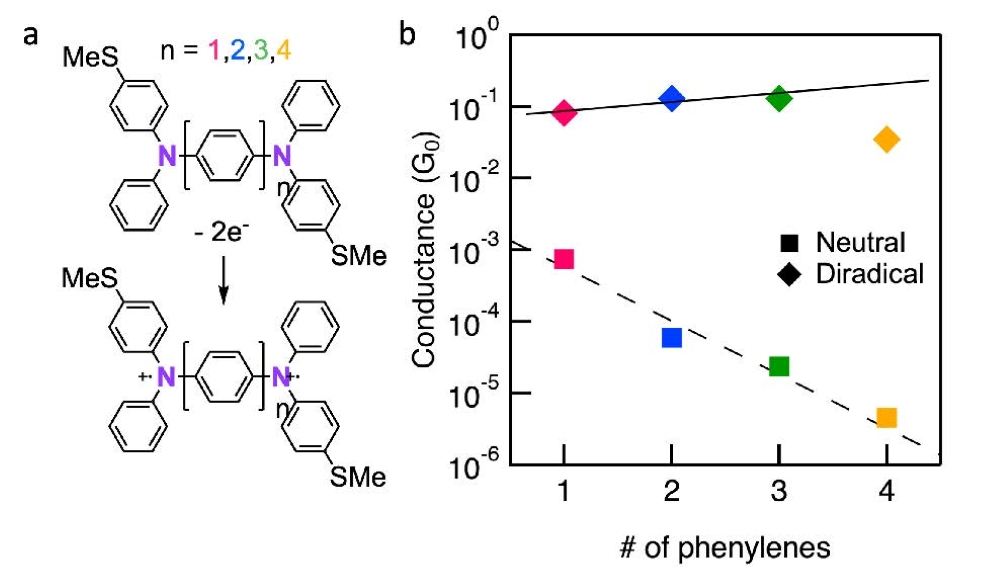
Using our custom-built scanning probe instrument, we recently created single-molecule devices with long molecular wires. [Li et al, Nat. Chem. 2022] Traditionally, conjugated molecular wires exhibit a low conductance that decreases with increasing molecular length. In contrast, a topological insulator can, in principle, overcome this limitation and show an increasing conductance with increasing length. These systems conduct through special edge states while remaining insulating in the bulk; these edge states are topologically protected, making them robust to defects and fluctuations. To translate this concept to an actual molecular circuit, we designed a series of oligophenylene-bridged bis(triarylamine) molecules capable of undergoing two-electron oxidation to form di-radical (edge state)-terminated wires. We measured their conductance in the neutral (i.e. standard conjugated form) and diradical (topological form). In the neutral state, we had the standard exponential decay of conductance with length while in the diradical state, we observed a reversal of the usual length dependence: the conductance increased with wire length. This behavior is precisely what had been predicted for SuSchriefferHeeger (SSH)type one-dimensional topological insulators. Notably, a 2.6 nmlong dication wire exhibited conductance exceeding 0.1 , representing a 5400-fold enhancement compared to its neutral form.