
Physics Animation & Geometry Processing
Computer Science

Christopher Wojtan
Professor
1 Career
- Since 2024 Area Chair for Information and Systems Sciences, Institute of Science and Technology Austria (ISTA)
- Since 2016 Professor, Institute of Science and Technology Austria (ISTA)
- 2011 – 2015 Assistant Professor, Institute of Science and Technology Austria (ISTA)
- 2010 PhD, Georgia Institute of Technology, Atlanta, GA, USA
- Summer 2008, Winter 2009 Visiting Researcher ETH Zürich, Switzerland
- Fall 2006 Visiting Researcher, Carnegie Mellon University, Pittsburgh, PA, USA
- Summer 2004, Visiting Researcher, Lawrence Livermore National Laboratory, CA, USA
1.1 Selected Distinctions
- 2025 Keynote Speaker, Symposium on Geometry Processing, Bilbao, Spain
- 2022 Keynote Speaker, GraPhyz Conference, Saline Royale d’Arc-et-Senans, France
- 2022 Papers Chair, Pacific Graphics Conference, Kyoto, Japan
- 2016 ACM SIGGRAPH Significant New Researcher Award
- 2015 Eurographics Young Researcher Award
1.2 Selected Grants
- 2022 – 2027 European Research Council (ERC) Consolidator Grant 101045083. “CoDiNA: Computational Discovery of Numerical Algorithms” Awarded to RG €1,550,402.
- 2015 – 2020 European Research Council (ERC) Starting Grant 638176. “Big Splash: Efficient Simulation of Natural Phenomena at Extremely Large Scales” Awarded to RG €1,500,000.
1.3 Tech Transfer (Patents, Spin-Offs)
N/A
1.4 Selected Publications
- G. Sperl et al., “Homogenized yarn-level cloth,” ACM Transactions on Graphics (SIGGRAPH North America), vol. 39, no. 4, pp. 48:1-48:15, Aug. 2020, issn: 0730-0301. DOI: 10.1145/3386569.3392412. [Online]. Available: https://doi.org/10.1145/3386569.3392412.
- S. Ishida et al., “A model for soap film dynamics with evolving thickness,” ACM Transactions on Graphics (SIGGRAPH North America), vol. 39, no. 4, pp. 31:1-31:11, Aug. 2020, issn: 0730-0301. DOI: 10.1145/3386569.3392405. [Online]. Available: https://doi.org/10.1145/3386569.3392405.
- C. Hafner et al., “Spin-it faster: quadrics solve all topology optimization problems that depend only on mass moments,” ACM Transactions on Graphics (SIGGRAPH North America), vol. 43, no. 4, pp. 78:1-78:13, July 2024, issn: 0730-0301. DOI: 10.1145/3658194. [Online]. Available: https://doi.org/10.1145/3658194.
- P. Heiss-Synak* & A. Kalinov* et al., “Multi-Material Mesh-Based Surface Tracking with Implicit Topology Changes,” ACM Transactions on Graphics (SIGGRAPH North America), vol. 43, no. 4, pp. 54:1-54:14, July 2024, issn: 0730-0301. DOI: 10.1145/3658223. [Online]. Available: https://doi.org/10.1145/3658223.
- Y-L. Chen et al., “Numerical homogenization of sand from grain-level simulations,” ACM Transactions on Graphics (SIGGRAPH Asia), vol. 44, no. 6, pp. 220:1-220:23, Dec. 2025, issn: 0730-0301. DOI: 10.1145/3763344. [Online]. Available: https://doi.org/10.1145/3763344.
2 Group Members
- Yi-Lu Chen, PhD Student since 2021
- Aleksei Kalinov, PhD Student since 2022
- Mauricio Rojas-Vega, PhD Student since 2023 (co-affiliated with the Saric Group)
- Evgeny Zuenko, PhD Student since 2024
- Sadashige Ishida, Postdoc since 2025
- Mickaël Ly, Postdoc since 2021
- David Palmer, Postdoc since 2025
- Ryusuke Sugimoto, Postdoc since 2025
- Christian Hafner, Research Technician since 2023
3 Research
Computational simulations of natural phenomena are essential in science, engineering, product design, architecture, and computer graphics applications. However, despite progress in numerical algorithms and computational power, it is still extremely difficult to compute detailed simulations at large scales. To make matters worse, visually rich natural phenomena like turbulent splashing liquids, fracture solids, knitted fabrics, and flowing sand rely on delicate coupling between small-scale details and large-scale behavior. Brute-force computation of such phenomena is intractable, and typical techniques from the engineering community are too fragile, too costly, or too crude to capture subtle features at small scales.
Our research develops efficient numerical algorithms for the simulation and visual animation of large-scale and highly detailed natural phenomena, and we solve related problems involving large-scale and noisy geometric shapes. To address these problems, we introduce novel geometric theory to derive efficient semi-analytic solutions where previously only brute-force algorithms were known;
we employ numerically robust software engineering to advance the frontier on historically stubborn problems (e.g., evolving non-manifold meshes with topological changes); and we use numerical homogenization to deduce efficient continuum dynamics methods from small-scale simulations like granular materials and knitted/woven fabric.
3.1 Current Scientific Projects/Directions
- Homogenized simulation of granular dynamics
- Efficient computation of generalized winding numbers in arbitrary dimension
- Physics-driven surface details for extremely deformable surfaces
- Surface completion algorithms based on circles of confidence
- Interface-only simulation of multiphase fluids
- Efficient optimization of the shapes of biological membranes (collaboration with Sarich Group)
- Simulation of water surface waves
- Simulation of developable ribbons
- Numerical calculation of inverse Laplace problems
- Stable computation of magnetohydrodynamics on arbitrary manifolds
- Numerical solution of inverse problems in granular dynamics based on semidefinite programs
- Monte-Carlo methods for geometry processing, especially Helmholtz equation
- Numerical simulation of liquid crystal elastomer kirigami materials (collaboration with Palacci group)
3.2 Research in Focus
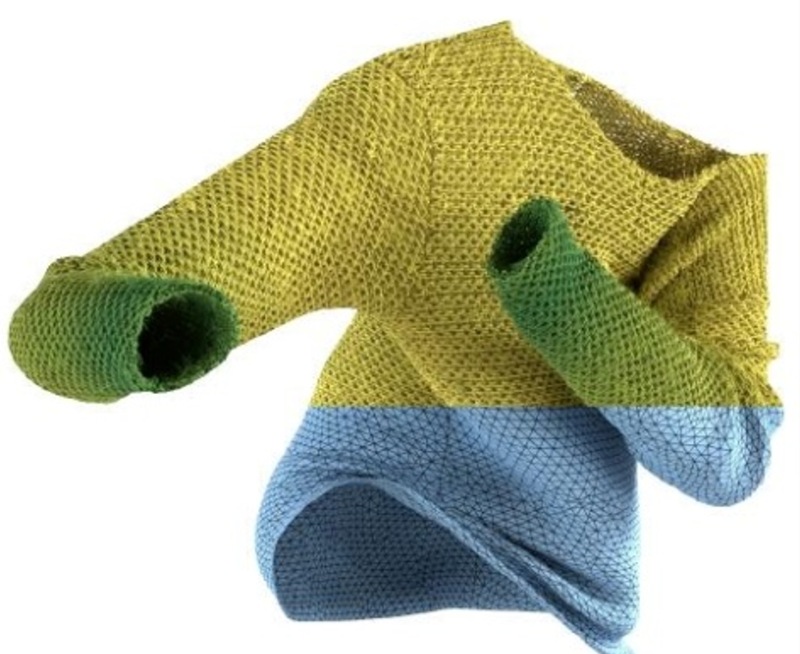
The simulation and analysis of yarn-level cloth is an area of intense focus in the computer graphics, materials science, and physics communities. Woven and knitted materials can exhibit a wide array of geometrically complex behaviors (highly variable stretchiness, anisotropy, area-preservation effects, etc.). They can be produced from simple threads or wires, leading to their ubiquity in everyday life. Furthermore, these materials are fascinating from a theoretical point of view, because their varying material properties arise almost entirely from the geometric structure of the threads — subtly different stitch patterns can lead to dramatically different material behaviors.
This work determines material properties directly from yarn-level geometry using numerical homogenization. We precompute the effective material response from periodic yarn-level simulations, learn an approximate material model from the resulting data, and incorporate this new material into an off-the-shelf cloth simulator. This paper demonstrates the first use of numerical homogenization for animating woven and knitted fabrics, introduces novel co-rotated periodic boundary conditions for the nonlinear homogenization of thin shells, and prescribes a procedure for fitting a material model capable of reproducing common textile phenomena such as anisotropy, area-preservation, and curling.
This work was published in ACM Transactions on Graphics (SIGGRAPH): Sperl et al. “Homogenized Yarn-Level Cloth” (2020). It laid the foundation several future papers by our group and others, which learn the effective behavior of cloth from small-scale simulated examples. This work and its derivatives have been incorporated into workflows of companies in the garment industry such as Clo3D, Style3D, and Under Armour. The first author has gone on to become a research scientist in this industry.

