
Epigenetics and Chromatin
Biology

Daniel Zilberman
Professor
1 Career
- Since 2021 Professor, Institute of Science and Technology Austria (ISTA)
- 2017 – 2021 Group Leader, Department of Cell & Developmental Biology, John Innes Centre, Norwich, UK
- 2013 – 2017 Associate Professor, Department of Plant & Microbial Biology, University of California, Berkeley, USA
- 2007 – 2013 Assistant Professor, Department of Plant & Microbial Biology, University of California, Berkeley, USA
- 2004 – 2007 Postdoctoral Fellow, Division of Basic Sciences, Fred Hutchinson Cancer Research Center, Seattle, USA
- 2004 PhD in Molecular, Cell & Developmental Biology, University of California, Los Angeles, USA
1.1 Selected Distinctions
- Since 2015 Reviewing Editor, eLife, Cambridge, UK
- 2016 HHMI-Simons Foundation Faculty Scholar
- 2009 Arnold and Mabel Beckman Young Investigator
1.2 Selected Grants
- 2017 – 2023 HORIZON-ERC-2016 Consolidator Award (725746), Quantitative analysis of DNA methylation maintenance within chromatin. Awarded overall: € 2,749,962; awarded to RG: € 2,749,962.
1.3 Tech Transfer (Patents, Spin-Offs)
N/A
1.4 Selected Publications
- J Rodrigues et al., “Divergence among rice cultivars reveals roles for transposition and epimutation in ongoing evolution of genomic imprinting”. PNAS, vol. 118: e2104445118, 2021. DOI: 10.1073/pnas.2104445118.
- J Choi et al., “Histone H1 prevents non-CG methylation-mediated small RNA biogenesis in Arabidopsis heterochromatin”. eLife, vol. 10: e72676, 2021. DOI: 10.7554/elife.72676.
- D. Lyons et al., “Extensive de novo activity stabilizes epigenetic inheritance of CG methylation in Arabidopsis transposons”. Cell Reports, vol. 43: 112132, 2023. DOI: 10.1016/j.celrep.2023.112132.
- A. Briffa et al., “Millennia-long epigenetic fluctuations generate intragenic DNA methylation variance in Arabidopsis populations”. Cell Systems, vol. 14: 953-967, 2023. DOI: 10.1016/j.cels.2023.10.007.
- Z. Shahzad et al., “Gene body methylation regulates gene expression and mediates phenotypic diversity in natural Arabidopsis populations”. Nature Plants, vol. 11: 2084–2099, 2025. DOI: 10.1038/s41477-025-02108-4.
2 Group Members
- Nona Boustan, PhD Student since 2022
- Vu Nguyen, Postdoc since 2025
- Minerva Trejo Arrellano, Postdoc since 2021
- Elizabeth Hollwey, Research Technician since 2024
3 Research
Most of the information that passes across generations is encoded in the DNA sequence. However, there is increasing appreciation that cells and organisms also receive inherited information through other mediums, known collectively as epigenetic. The Epigenetics and Chromatin group studies cytosine DNA methylation, a key epigenetic mechanism in plant and animal cells.
Cytosine methylation can carry epigenetic information because it is precisely copied when the DNA is replicated. Methylation regulates gene expression, and accurate reproduction of DNA methylation patterns during cell division is therefore essential for plant and animal development, efficient agriculture, and human health.
The enzymes that maintain DNA methylation must work within chromatin, and particularly to contend with nucleosomes – tight complexes of DNA and histone proteins.
The Epigenetics and Chromatin group combines genetic, genomic, biochemical, and evolutionary approaches to understand the maintenance and function of DNA methylation within chromatin using the flowering plant Arabidopsis thaliana as the primary model. The group also studies a variety of other species to understand the complex evolution of eukaryotic DNA methylation.
3.1 Current Scientific Projects/Directions
- Regulation of DNA methylation patterns by chromatin remodelers and linker histones
- Mathematical modeling of DNA methylation inheritance
- DNA methylation as a mechanism of long-term epigenetic inheritance
- Evolution of eukaryotic DNA methylation pathways
- Epigenetic inheritance as a mechanism of phenotypic diversification in natural populations
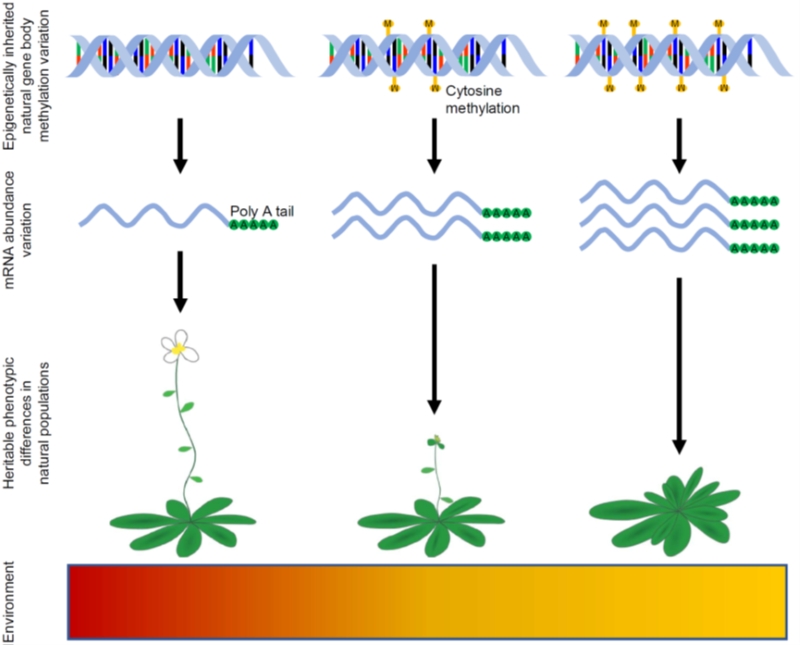
3.2 Research in Focus
Although epigenetic information inherited independently of DNA sequence can, in principle, be a basis for evolution by natural selection, whether this occurs in natural populations was unknown. Our previous work (A. Briffa et al., Cell Systems, 2023) showed that gene body methylation (gbM) – a form of DNA methylation that had long been functionally and mechanistically mysterious – has the properties needed to epigenetically mediate evolution on millennial timescales. In this study, we showed that single nucleotide and gbM polymorphisms explain comparable amounts of gene activity (mRNA abundance) variance in Arabidopsis thaliana populations. We demonstrated that gbM regulates gene expression, and we identified and genetically validated many associations between gbM polymorphism and the variation of complex traits: fitness under heat and drought, flowering time, and accumulation of diverse minerals. We developed an epigenome-wide association method that pinpointed trait-relevant genes with greater precision than genetic association analyses. Finally, we identified numerous associations between gbM variation and diverse environmental conditions in native habitats, suggesting that gbM facilitates adaptation. Overall, our results indicate that epigenetic methylation variation fundamentally shapes phenotypic diversity in a natural population, and can be a substrate for evolution. This work was published: Z. Shahzad et al., Nature Plants 11: 2084–2099 (2025).

